On 31 October, you might enjoy decorating your home and taking your children or grandchildren trick-or-treating for Halloween. It’s a season of enjoyable scares and fun-filled spookiness.
However, you may have some financial fears that bring less joy. In fact, these anxieties might hold you back from making the most of your wealth.
Keep reading to learn about three common money worries and find out how you could overcome them to boost your financial wellbeing.
1. “I’m scared of running out of money in retirement”
According to the findings of an Oxford Risk study, published by IFA Magazine, half of over-55-year-olds are worried that their retirement savings won’t last their lifetime.
Research published by PensionsAge suggests that these fears may be well-founded for many people, as 39% of UK adults aren’t on track to afford a minimum retirement lifestyle.
According to Pensions UK’s Retirement Living Standards, a single person needs £13,400 per year to afford a minimum standard of living in retirement, while a couple needs £21,600. This rises to £43,900 and £60,600 a year respectively for a comfortable retirement.
You’ll likely need a significant savings pot to cover these costs. For example, if you retire at 55 and live to 85, your retirement funds will need to last 30 years. Moreover, inflation may rise over time, which could increase your cost of living.
As such, overcoming this fear and securing the retirement lifestyle you desire requires careful planning. Key things to consider include:
- How long your retirement is likely to last – Think about your preferred retirement age and try using the Office for National Statistics’ (ONS) life expectancy calculator to gauge how long your funds may need to last.
- Your retirement income needs – Consider your preferred lifestyle, goals, and how your spending might change during your retirement. For example, you could face increased healthcare costs in later life.
- Your savings and investments – Review all your sources of retirement income, such as pensions, investments, and earnings from rental property. This could help you identify and address any potential shortfall in your retirement funds.
You might benefit from consulting a financial planner who can use cashflow modelling to provide a clear picture of your retirement income needs and create an action plan for achieving your goals.
Read more: 5 top retirement planning tips to help you feel more confident about your financial future
2. “I’m worried about losing money if I invest in the stock market”
Recent findings published by Money Marketing reveal 42% of UK adults keep all their wealth in cash despite 72% saying they know this could leave them worse off in the long run. Among the top reasons cited were a “fear of losses” (38%) and “distrust of markets” (34%).
However, holding too much in cash could put you at risk of losing more money than investing in the stock market.
This is because even modest rates of inflation could erode the real value of your cash savings over time.
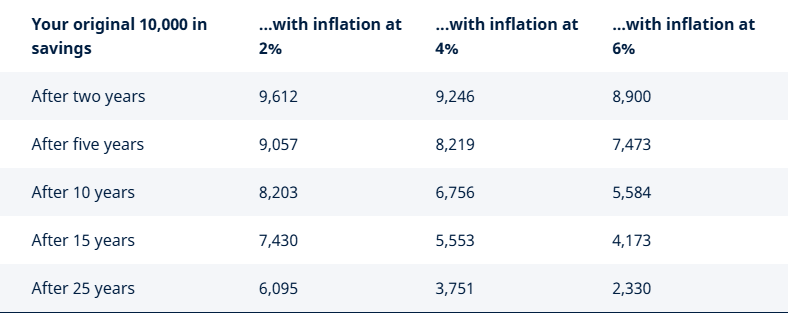
The Schroders data below shows how different levels of inflation could affect the spending power of £10,000 cash savings over 25 years.
Source: Schroders. Assumes no cash interest is earned on the original deposit.
As you can see, even a relatively low level of 2% inflation could diminish the value of your savings significantly over time.
In contrast, investing some of your wealth in the stock market may generate higher returns and give you a better chance of outpacing inflation.
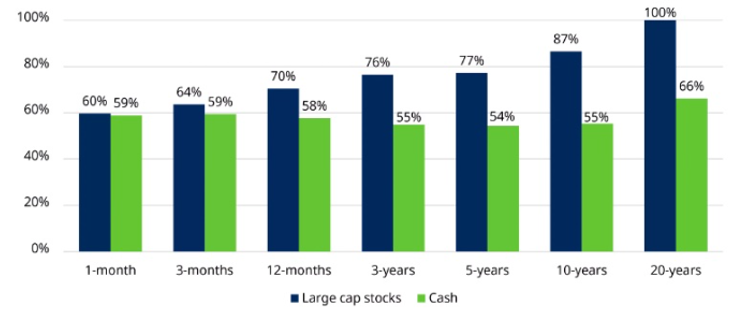
This chart, published by Schroders, shows the percentage of time periods in which US stocks and cash beat inflation between 1926 and 2022.
Source: Schroders
This data shows that investments consistently outperformed cash savings. Moreover, the longer investments were held, the more likely they were to outpace inflation.
If your anxiety about losing money makes you hesitant to invest, a financial planner can help you create a diversified portfolio that aligns with your tolerance for risk and your long-term goals. Through personalised coaching and support, they can help you face your fear and become a confident investor.
3. “I’m fearful that my children’s inheritance will be eroded by tax”
The latest data released by HMRC shows that Inheritance Tax (IHT) receipts for the period April to August 2025 reached £3.7 billion, which is £0.2 billion higher than the same period last year.
This is largely due to frozen IHT thresholds, which haven’t kept pace with inflation. As a result, more estates are triggering an IHT charge or facing a larger tax bill.
Additionally, from April 2027, pensions will no longer be exempt from IHT, which could increase the annual number of IHT receipts further still.
If you’re worried about your family’s inheritance being diminished by your estate’s tax liabilities, a financial planner can help you mitigate a potential IHT bill by:
- Maximising IHT allowances
- Gifting some of your wealth during your lifetime
- Setting up trusts to pass on wealth tax-efficiently
- Embedding IHT planning in your broader estate plan
- Using life insurance to cover your estate’s IHT liabilities
- Adjusting your plans in line with changes to tax legislation.
Moreover, your financial planner can use advanced cashflow modelling to forecast the future value of your estate and estimate your IHT liabilities. This could provide the clarity you need to leave a meaningful legacy for your loved ones without compromising your lifestyle.
Get in touch
If your financial fears are holding you back from achieving your goals, we can help.
Our financial planners can provide the guidance and support you need to overcome these barriers and make the most of your wealth.
Please email hello@bluewealth.co.uk or call us on 0117 332 0230.
Please note
The content of this newsletter is offered only for general informational and educational purposes. It is not offered as, and does not constitute, financial advice.
Blue Wealth Ltd is not responsible for the accuracy of the information contained within linked sites.
Blue Wealth Ltd is an appointed representative of Best Practice IFA Group Ltd, which is authorised and regulated by the Financial Conduct Authority.
Please do not act based on anything you might read in this article. All contents are based on our understanding of HMRC legislation, which is subject to change.
A pension is a long-term investment not normally accessible until 55 (57 from April 2028). The fund value may fluctuate and can go down, which would have an impact on the level of pension benefits available. Past performance is not a reliable indicator of future performance.
The tax implications of pension withdrawals will be based on your individual circumstances. Thresholds, percentage rates, and tax legislation may change in subsequent Finance Acts.
The value of your investments (and any income from them) can go down as well as up and you may not get back the full amount you invested. Past performance is not a reliable indicator of future performance.
Investments should be considered over the longer term and should fit in with your overall attitude to risk and financial circumstances.
Note that life insurance and financial protection plans typically have no cash in value at any time and cover will cease at the end of the term. If premiums stop, then cover will lapse.
Cover is subject to terms and conditions and may have exclusions. Definitions of illnesses vary from product provider and will be explained within the policy documentation.
Approved by Best Practice IFA Group: 21/10/25