Author: Rob Bowers

Your Spring Statement update – the key news from the chancellor’s speech

Big Ben

Just over three months after her lengthy Autumn Budget, chancellor Rachel Reeves has addressed the House of Commons and delivered the government’s 2026 Spring Statement.

Ahead of the Statement, Reeves reinforced the government’s commitment to “one fiscal event, one Budget, a year”. So, it will come as a relief to many, including business owners, that the Spring Statement included no additional tax-raising measures. Furthermore, no changes to pensions or Individual Savings Accounts (ISAs) were announced.

Reeves also said that household disposable income is set to grow at twice the rate that was forecast in the Autumn Budget – leaving the average person £1,000 better off each year by the next election.

That being said, previous announcements, including changes to the tax regime, remain in place, and may affect personal finances and business owners in 2026/27 and beyond.

Reeves gave an overview of the Office for Budget Responsibility’s (OBR) economic forecast for the years to come. Notably, the OBR’s forecasts and the Statement as a whole made no mention of the potential economic impact of the unfolding situation in the Middle East, which may contribute to increased oil and gas prices that could prove inflationary and cause stock market volatility.

The chancellor confirmed the changes announced in the 2024 and 2025 Budgets

In an effort to reduce speculation and prevent a chop-and-change approach, the chancellor confirmed that key tax measures, announced in the Autumn Budgets of 2024 and 2025, will remain in place.

Among the key changes that have been reconfirmed and will affect personal finances are:

  • Inheritance Tax (IHT) will be levied on most unused pension benefits from April 2027. It’s estimated that this change will result in an additional 10,500 estates being liable for IHT in 2027/28. This will contribute to a predicted rise in IHT receipts to £15 billion by 2030.
  • Tax on income earned from property will rise by two percentage points from April 2027, increasing tax liability for landlords.
  • There will also be a two percentage point increase in the basic and higher rates of Dividend Tax from April 2026, which may affect business owners and investors.
  • Key tax thresholds, including those for Income Tax and the IHT nil-rate bands, will remain frozen until April 2031.

The lack of any tax-raising measures in the Spring Statement will be welcome news for many people. However, the previously announced changes could mean a review would still be beneficial.

The Office for Budget Responsibility has updated its forecasts for GDP growth, inflation, and house prices

The OBR has updated its real-terms GDP forecast every year between 2026 and 2029 when compared to the estimates it made in the 2025 Autumn Budget. The organisation now expects the economy to grow by:

  • 2026 – 1.1% (a decrease of 0.3%)
  • 2027 – 1.6% (unchanged)
  • 2028 – 1.6% (an increase of 0.1%)
  • 2029 – 1.5% (unchanged)

The OBR expects inflation to be at or around the Bank of England’s (BoE) 2% target over the next five years. Inflation easing would improve household spending power, which, in turn, could provide a boost for the economy and businesses. Indeed, real household disposable income is expected to grow by between 0.6% and 0.9% each year until 2030.

The BoE has already cut its base interest rate several times since the current government formed in July 2024, as inflationary pressures eased. If the OBR’s forecast is accurate, the BoE is likely to make additional cuts, which would reduce the cost of borrowing for households and businesses.

The OBR expects unemployment to rise from 4.75% in 2025 to a peak of 5.33% in 2026, driven by weaker demand for labour. After peaking in 2026, unemployment is expected to fall to 4.1% in 2030.

It also forecasts that house prices will rise by between 2.4% and 2.9% each year between 2026 and 2030.

The government reinforced its ongoing commitment to two key fiscal rules

In her speech, the chancellor confirmed the two fiscal rules set out in the Budget:

  • Stability rule – Not to borrow money to fund day-to-day public spending by the end of this parliament (2029/30).
  • Investment rule – To reduce government debt as a share of national income by 2029/30.

Addressing the stability rule first, although the cost of borrowing has risen during this period of heightened uncertainty, the chancellor vowed that the steps taken in the Statement will restore its headroom.

Turning next to the investment rule, Reeves also stated that this commitment will be met two years early, with net financial debt predicted to be 82.9% of GDP in 2025/26.

4 key Spring Statement measures

1. Boosting defence spending

At a time of growing worldwide tension, the chancellor announced increases to defence spending, aimed at making the UK a “defence industrial superpower”. Defence spending is set to reach 3.5% of GDP by 2035.

Defence innovation will include harnessing AI and drones, creating employment opportunities for engineers in the devolved nations, while a previously announced Defence Growth Board is also being created to support £400 million for defence innovation.

2. Tackling youth unemployment

The chancellor reconfirmed her commitment to getting those in Britain who can work into work. She stated that 1 in 8 young people is currently not in employment, education, or training.

The chancellor confirmed that reforms to the welfare system will produce welfare savings of £4.8 billion between 2026 and the end of the forecast period (2029/30).

3. Increasing property revenue

Previously announced property planning reforms will go ahead.

The reforms are expected to increase real levels of GDP by 0.2%, the equivalent of £6.8 billion for the economy, by 2029/30. Over 10 years, this is expected to increase to 0.4% of GDP (£15 billion). Reeves said this represents the biggest growth forecast for a policy with no fiscal cost.

4. Making government more efficient

The abolition of NHS England was announced back in March 2025 as part of wider efforts to increase NHS efficiency and productivity, and to cut spending. These measures will also include reducing costly agency outsourcing.

More widely, Reeves confirmed the £3.25 billion of investment in a new “transformation fund” that will drive modernisation across the public sector through digital reform and the adoption of AI. It’s hoped that these changes will result in a “leaner” and more efficient public sector.

After announcing a raft of changes in the Autumn Budget, the Spring Statement acts as a fiscal pitstop, upholding the government’s commitment to one significant fiscal event a year.

Please note

All information is from the chancellor’s speech, the gov.uk website, the Spring Statement press release and the Autumn Budget documents published by HM Treasury.

The content of this Spring Statement summary is intended for general information purposes only. The content should not be relied upon in its entirety and shall not be deemed to be or constitute advice.

While we believe this interpretation to be correct, it cannot be guaranteed, and we cannot accept any responsibility for any action taken or refrained from being taken as a result of the information contained within this summary. Please obtain professional advice before entering into or altering any new arrangement.

The Financial Conduct Authority does not regulate tax planning.

The value of your investments (and any income from them) can go down as well as up and you may not get back the full amount you invested. Past performance is not a reliable indicator of future performance.

Investments should be considered over the longer term and should fit in with your overall attitude to risk and financial circumstances.

Team update: Adrian Thorley’s 60th birthday celebrations

Adrian Thorley is one of our most experienced Chartered financial planners, with 37 years of experience in the profession.

At the end of January, the team got together to celebrate the big 6-0.

Here’s a little taster of the fun we had…

A great venue and fantastic company

On 29 January, Adrian’s 60th birthday, seven of the Blue Wealth team, and a good friend who works alongside us, left the office just before 5 pm for an evening of celebration.

We’d booked a table at a local restaurant for 7 pm, giving us plenty of time for a few pre-dinner drinks.

After an arduous 400-yard walk from Blue Wealth’s headquarters, we arrived at The Brewhouse & Kitchen, a fantastic pub that brews award-winning craft beers on site.

After one (or two) drinks and a lot of merriment, we headed across the road to the Black Cumin, a local curry house we’d all wanted to try for some time. We weren’t disappointed. The venue was nicely decorated, and the staff were immediately friendly.

It was very busy, even though it was a damp Thursday night near the end of Dry January. We thought that was a good sign – especially at the end of a long month when finances are often stretched.

We settled in and ordered some more celebratory drinks – you only turn 60 once, after all! – before deliberating over the mouth-watering menu.

Adrian was almost defeated by a VERY hot curry!

There was a huge range of original dishes, alongside the classics. We were spoilt for choice.

Adrian said, “The dishes had unusual names, and there were no clues as to what was hot and what was less so.”

After his meal arrived, Adrian realised quickly that there was a considerable level of heat on his plate.

“I knew I was in trouble when the chef appeared to ask if I was okay, armed with another naan bread which seemed to be intended as a fire blanket!

“Beware of McLeod Ganj Chilli Chicken if you see it on a menu at an Indian near you…”

On a more serious note: A brief word about making end of tax-year pension withdrawals

Now the birthday celebrations are over, we’re back in the office working hard to help you with all your financial planning needs, and the end of the 2025/26 tax year is rapidly approaching on 5 April.

If you’re thinking about making an ad‑hoc pension withdrawal before the new tax year begins, be sure to contact your Blue Wealth financial planner before the end of February.

We can help you understand the tax and long-term implications of taking funds from your pensions and ensure that any withdrawals fit within your overall retirement plans.

Please contact us by email at hello@bluewealth.co.uk or call us on 0117 332 0230.

International Women’s Day: How a financial planner can help women take control of their wealth

On 8 March, people around the world will celebrate International Women’s Day. This important event recognises the achievements of women and raises awareness of ongoing gender equality issues.

Over recent decades, women have gained greater access to education and broader career opportunities, leading to higher earnings and business success.

According to the World Economic Forum, women are expected to hold 40% of global investable wealth by 2030. What’s more, research findings published by IFA Magazine reveal that in 2024, 53% of women reported feeling financially independent, which is an 8% increase from 2022.

And yet, in 2026, women continue to face unique financial challenges, meaning they often need to approach financial planning differently from men if they want to build lasting security.

Keep reading to learn about some of the financial barriers women face and find out how a financial planner could provide the bespoke guidance they need to take control of their wealth.

Women face unique financial challenges throughout their lives

Every woman’s financial circumstances, experiences, and needs are different. However, there are some common challenges many women share, including:

The gender pay gap

While the disparity between men’s and women’s pay has reduced over time, according to the Office for National Statistics (ONS; 23 October 2025), the gender pay gap currently stands at 6.9%.

In other words, women still earn, on average, less than men for similar work, reducing how much they have to save and invest for the future.

The gender pensions gap

Findings from a recent University of Edinburgh study published by Pensions Age show that by age 60, men have, on average, nearly four times as much in their pension pots as women.

This could leave women with lower retirement incomes, which could limit their choice and independence. It could also increase their risk of running out of money later in life.

The financial confidence gap between men and women

Research by the charity National Numeracy reveals a persistent gender gap in financial confidence and numeracy. Nearly three times as many women (17%) as men (6%) reported low confidence in working with numbers. Additionally, just 77% of women said they feel confident making financial decisions, compared with 88% of men.

This gap in self-belief is particularly marked when it comes to investing. According to FTAdviser, only 33% of women are confident making investment decisions compared with 57% of men.

A lack of financial confidence could lead women to miss out on valuable opportunities to build and preserve wealth, potentially widening gender wealth gaps over time.

3 important ways a financial planner can support women to build and manage their wealth

Fortunately, there are steps women can take to overcome the challenges they face and build the financial futures they want.

Here are three crucial ways a financial planner can help:

1. Provide a clear picture of their current financial situation and future needs

A financial planner can use sophisticated cashflow modelling software to give their female clients a holistic overview of their current finances by mapping all income, outgoings, assets, and liabilities.

Knowing exactly where money is coming from and going to each month could highlight opportunities for redirecting unnecessary spending to savings, pensions, and other investments.

A financial planner can also project current cashflows forwards to help their clients understand future income needs, gauge their progress towards long-term goals, and address any potential shortfalls.

For example, if it looks like lower earnings or career breaks may result in a smaller pension pot than a woman is likely to need, a financial planner can test different strategies for catching up financially – such as increasing pension contributions or delaying retirement.

This approach could empower women to identify actionable steps for overcoming challenges and developing greater financial security.

2. Build their financial confidence and literacy

At Blue Wealth, we build lasting relationships with our clients through active listening, empathy, and tailored support. This starts with jargon-free conversations that help us learn about an individual’s needs, concerns, and life ambitions.

These discussions allow us to identify any gaps in knowledge, understanding, or self-belief that could be holding an individual back from progressing towards their financial goals.

Over time, our financial planners can bolster a woman’s financial literacy and confidence by:

  • Prioritising key areas of learning and focusing on one at a time to avoid overwhelm
  • Using visual tools, such as cashflow modelling, to explain an individual’s finances in an accessible way
  • Creating a safe space in which women feel comfortable asking questions and sharing concerns
  • Acknowledging milestones and celebrating progress.

As such, a financial planner can help women feel informed and in control, turning uncertainty into clarity.

3. Offer support during major life transitions

Life events such as divorce, career breaks, or changes in caring responsibilities could significantly affect a woman’s current and future finances.

A financial planner can offer both practical and emotional support during these major transitions, including:

  • Acting as an impartial sounding board for female clients’ financial concerns
  • Supporting women to plan financially for a career break
  • Reviewing and adjusting financial plans in line with changed circumstances and goals
  • Helping women understand their options and entitlements, such as those around pension sharing on divorce
  • Advising on estate planning after a bereavement or a serious medical diagnosis
  • Offering guidance on balancing financial responsibilities for children or elderly parents with a woman’s long-term goals
  • Providing ongoing check-ins and support to rebuild confidence and independence.

As such, a financial planner can provide the continuity, reassurance, and guidance women need to take control of their wealth and maintain their financial resilience, whatever challenges they face.

Get in touch

If you’d like to find out more about how we can help you and the women in your family face their financial futures with confidence, please get in touch.

To find out more, please email hello@bluewealth.co.uk or call us on 0117 332 0230.

Please note

The content of this newsletter is offered only for general informational and educational purposes. It is not offered as, and does not constitute, financial advice.

Blue Wealth Ltd is not responsible for the accuracy of the information contained within linked sites.

Please do not act based on anything you might read in this article. All contents are based on our understanding of HMRC legislation, which is subject to change.

The Financial Conduct Authority does not regulate estate planning or cashflow planning.

A pension is a long-term investment not normally accessible until 55 (57 from April 2028). The fund value may fluctuate and can go down, which would have an impact on the level of pension benefits available. Past performance is not a reliable indicator of future performance.

The tax implications of pension withdrawals will be based on your individual circumstances. Thresholds, percentage rates, and tax legislation may change in subsequent Finance Acts.

The value of your investments (and any income from them) can go down as well as up and you may not get back the full amount you invested. Past performance is not a reliable indicator of future performance.

Investments should be considered over the longer term and should fit in with your overall attitude to risk and financial circumstances.

Approved by best practice on: 19/02/26

Your 2026 beginner’s guide to Stocks and Shares ISAs

One of the headline announcements in the chancellor’s Autumn Budget, delivered on 26 November 2025, was reform of the Individual Savings Account (ISA) allowance for under-65s.

Currently, adults can contribute £20,000 across their ISAs, including Cash ISAs and Stocks and Shares ISAs, each tax year.

While the overall ISA allowance of £20,000 remains unchanged, from April 2027, the Cash ISA limit will be cut to £12,000. The remaining £8,000 of this allowance will be reserved exclusively for investments. As such, you could put up to £20,000 in Stocks and Shares ISAs in a single tax year or split this allowance between Cash ISAs (limited to £12,000) and investment accounts.

Nothing will change for savers over the age of 65 who will continue to have the £20,000 allowance for Cash ISAs.

The government hopes this will encourage more people to invest in the stock market. However, according to research by The Investment Association, 1 in 5 UK adults have never heard of a Stocks and Shares ISA.

That’s why we’ve created this handy beginner’s guide to explain how this type of ISA works and highlight the potential benefits of investing in 2026. Keep reading to find out more.

How Stocks and Shares ISAs work: Your questions answered

A Stocks and Shares ISA is a tax-efficient investment account that allows you to invest your money in a wide range of assets, such as shares, bonds, and funds. Any investment growth or interest earned within a Stocks and Shares ISA is free from:

  • Income Tax
  • Capital Gains Tax (CGT)
  • Dividend Tax.

Who can open a Stocks and Shares ISA?

Anyone who is 18 or over and a UK resident for tax purposes can open a Stocks and Shares ISA. You’re also eligible if you’re a Crown employee working or serving overseas, such as a member of the armed forces or a diplomat, or you’re the spouse of a Crown employee.

The account must be opened by an individual – you cannot hold one in a joint name.

How much can I pay into a Stocks and Shares ISA?

In the 2025/26 tax year, you can pay a total of £20,000 tax-efficiently across all your ISA accounts. You could use some or all of this amount in Stocks and Shares ISAs.

Your annual allowance will reset at the start of the new tax year (6 April), and any unused allowance will be lost – it can’t be rolled over to the following year.

It’s up to you how you use your allowance; you can pay in a lump sum or make contributions throughout the tax year.

If you pay in more than your annual ISA allowance in a single tax year, any interest or gains on the excess amount will be taxable.

As mentioned above, from April 2027, if you’re under 65, £8,000 of your current £20,000 ISA allowance will be reserved exclusively for Stocks and Shares ISAs. You can choose whether to put the remaining £12,000 in a Cash ISA, a Stocks and Shares ISA or a combination of the two.

Can I have more than one Stocks and Shares ISA?

As of 6 April 2024, you can contribute to multiple Cash ISAs and Stocks and Shares ISAs in a single tax year. Just remember to bear the annual ISA allowance in mind to ensure your savings and investments remain tax-efficient.

Also, there are various fees associated with Stocks and Shares ISAs, such as platform and fund management fees. These costs can add up if you have more than one account.

5 compelling benefits of Stocks and Shares ISAs

Here are five reasons you might want to consider investing some of your savings in a Stocks and Shares ISA in 2026.

1. Your investments are protected from tax

The main benefit of investing through an ISA is that any income you receive and any capital gains you make are free from personal taxation, provided that you don’t exceed the annual subscription limit.

In contrast, any interest and gains you make on money held in a General Investment Account (GIA) could be liable for CGT, Dividend Tax, and Income Tax if your returns exceed certain amounts.

2. It’s easy to get started as a beginner investor

Research findings published by This is Money reveal that 11 million UK adults say they would like to invest but are held back by a lack of confidence. This is largely due to misconceptions about investing and a significant knowledge gap.

While it’s always wise to seek financial advice before investing, Stocks and Shares ISAs offer a simple way for beginners to get started. Setting up an account is generally a quick and easy online process, and there are lots of options for ready-made portfolios where your investments are selected and managed for you.

It’s worth speaking to a financial professional to ensure that your investment strategy is embedded in your broader financial plan.

3. There is no cap on your returns or total ISA value

While your ISA contributions are limited by the annual allowance, there are no such restrictions on the total value of your Stocks and Shares ISA or returns gained through your investments.

As such, keeping your wealth invested over the long term could deliver significant returns, allowing you to build a healthy savings pot for the future.

Indeed, This is Money has revealed that there are now more than 5,000 ISA millionaires in the UK, and the top 25 ISA investors have pots averaging £8.9 million. Moreover, Trustnet reports that 94% of ISA millionaires have Stocks and Shares accounts, while the remaining 6% use a combination of investments and Cash ISAs.

4. Plenty of choice allows you to diversify your investments

Putting all your eggs in one basket by investing in a single asset class could expose you to an unnecessary risk of losing money. That’s why diversifying your investments across asset types, sectors, and geographical regions is vital.

There is a wide range of investments that can be held in a Stocks and Shares ISA. This choice and flexibility allow you to spread the risk and align your portfolio with your values.

5. You could potentially achieve higher returns and beat inflation

If the interest you receive on your cash savings fails to keep pace with inflation, your money could lose purchasing power over time. In other words, the £1,000 you put in your Cash ISA in March 2024 might buy you less in March 2026.

Investing some of your wealth in Stocks and Shares ISAs could potentially deliver higher returns than cash savings alone, increasing your chances of beating inflation.

Of course, you might want to keep some cash savings for short-term expenses and emergencies. Additionally, the value of your investments could go down as well as up. As such, it’s prudent to seek financial advice before you start investing to ensure your strategy aligns with your tolerance for risk and your long-term goals.

Get in touch

Our financial planners can provide the knowledge and guidance you need to start investing with confidence in 2026.

To find out more, please email hello@bluewealth.co.uk or call us on 0117 332 0230.

Please note

The content of this newsletter is offered only for general informational and educational purposes. It is not offered as, and does not constitute, financial advice.

Blue Wealth Ltd is not responsible for the accuracy of the information contained within linked sites.

Please do not act based on anything you might read in this article. All contents are based on our understanding of HMRC legislation, which is subject to change.

The Financial Conduct Authority does not regulate tax planning.

The value of your investments (and any income from them) can go down as well as up and you may not get back the full amount you invested. Past performance is not a reliable indicator of future performance.

Investments should be considered over the longer term and should fit in with your overall attitude to risk and financial circumstances.

Blue Wealth is an Appointed Representative of Best Practice IFA Group Limited which is authorised and regulated by the Financial Conduct Authority, the registration number is 223112. Approved by Best Practice on: 23/12/25

Guide: Revealed: The value of financial planning

Financial planning can add real value to your life, helping you achieve your goals and enjoy the lifestyle you want.

When you think about financial planning, you might initially focus on the financial element.

Perhaps you’re interested in how planning can help you reduce your tax bill, invest to get the most out of your savings, or make sure you’re on track for retirement?

While financial planning can certainly help in these areas, it actually goes far beyond that. It’s all about helping you live the life you want, feel more confident about the future, and reach your goals.

When clients first approach a financial professional, it’s often because they need support with a specific question or concern, such as:

  • Can I afford to invest more of my wealth?
  • How much do I need to save to enjoy my lifestyle in retirement?
  • What can I do to reduce Inheritance Tax for my loved ones after I’m gone?

While a planner can help you answer questions like those above, the process of financial planning is even more all-encompassing, designed to deliver greater value.

In this guide, you can find out why.

Download your copy here: Revealed: The value of financial planningto discover how financial planning could help you achieve your long-term aspirations.

If you have any questions or would like to discuss how we could work together to build a financial plan, please contact us.

Please note: This article is for general information only and does not constitute advice. The information is aimed at retail clients only.

Team update – Our first Blue Wealth summer boat trip was a huge success

We were so excited to add a new event to the Blue Wealth social calendar this year – and it was a huge success!

On Thursday 3 July, we hosted our first summer boat trip on The Matthew, in Bristol.

Keep reading to find out more.

A gentle float along the water aboard a historic ship

A group of 40 clients and members of the Blue Wealth team met late afternoon at Princes Wharf on Thursday 3 July.

After an enjoyable 5 or 10 minutes catching up with familiar faces and meeting new ones, we boarded The Matthew, Bristol’s historic floating harbour, for a relaxing one-hour boat trip.

Great weather, delicious food, and exceptional company

We planned this event to show our appreciation to loyal clients, so we’re delighted that it was such a fantastic evening.

The weather was excellent – never a given during a British summer! – and everyone enjoyed soaking up a few rays under glorious blue skies as we coasted along the water.

We were particularly impressed by the knowledgeable, friendly crew and it was fascinating learning about The Matthew, which is run as a charity. All the money it raises is used to maintain the ship in peak condition for trips and educational visits.

After docking, we sat and chatted while eating some excellent food from The Jolly Hog.

It was a fantastic event, and we were thrilled to receive positive feedback from both staff and clients.

One of our guests said, “Thank you for treating us to such a delightful evening on board The Matthew. It was a very pleasant experience. The food from The Jolly Hog was delicious too!”

Keep your eye on team updates for news of future events. If you have any feedback on our summer boat trip or would like to share ideas for future socials, we’d love to hear from you.

Get in touch

To learn more about the Blue Wealth team and how we can help you with all your financial planning needs, please get in touch.

Please email hello@bluewealth.co.uk or call us on 0117 332 0230.

Please note

The content of this newsletter is offered only for general informational and educational purposes. It is not offered as, and does not constitute, financial advice.

Pension Awareness: 4 important facts you might not know about your pensions

Pensions are a crucial part of retirement planning. Even if you have multiple sources of income to support you and your loved ones when you leave work behind, pensions offer a valuable, tax-efficient way to save.

Yet, a recent survey by Aviva has revealed a critical “knowledge gap” about UK pensions. While 53% of respondents claimed to be knowledgeable about pensions, 20% did not know what type of scheme they were signed up to and 57% were unaware that the government pays tax relief on pension contributions.

With the Pension Awareness campaign running from 15 to 17 September, it’s the ideal time to take control of your retirement savings.

Read on to discover four important facts that could boost your understanding of pensions and help you build financial security for later life.

1. How much State Pension you’ll receive depends on your National Insurance record

The State Pension provides a valuable source of income for many UK adults. If you’re entitled to the full new State Pension (for those who reach State Pension Age on or after 6 April 2016), you will receive £230.25 a week in 2025/26, which is equivalent to £11,973 annually.

Under the triple lock arrangement, the new State Pension will increase each year in line with whichever is higher of:

  • Average earnings growth
  • Inflation
  • 2.5%.

However, the amount you’ll receive depends on your National Insurance (NI) record. You’ll typically need 10 qualifying years of National Insurance contributions (NICs) to receive any new State Pension and 35 qualifying years to receive the full amount.

The government website allows you to check your NI record online. If it looks like you may not have enough years of NICs to claim the full new State Pension, you may be able to pay voluntary contributions to fill any gaps in your record.

It’s important to note that you can only pay voluntary contributions for the past six tax years. For example, you have until 5 April 2032 to make up gaps for the 2025/26 tax year.

2. The State Pension is not paid automatically; you’ll need to claim it

You can claim your State Pension entitlement when you reach State Pension Age, which is currently 66 (2025/26), but will start to gradually increase from 6 May 2026.

The Pension Service should send you a letter around four months before you reach State Pension Age, explaining how to claim. You can do this in one of three ways:

  • Online
  • By phone
  • By post.

You’ll be asked to provide certain information, such as your banking details and the date of your most recent marriage, civil partnership, or divorce. If you’re applying online, you’ll also need the invitation code from your letter.

If you’re still working or have other sources of income to draw on, you might choose to delay claiming your State Pension to increase the amount you receive. Your entitlement increases by the equivalent of 1% for every nine weeks you defer, as long as you defer for at least nine weeks.

3. Pension providers invest your money to help it grow over time

Research published by PensionsAge found that more than half of adults in the UK don’t know that their private and workplace pension funds are invested.

This is how pensions providers aim to increase the value of your savings over time. They’ll usually invest your money in a range of asset classes, such as bonds, cash, stocks, shares, and property.

If you have a defined contribution (DC) pension scheme, your retirement income will depend on how well these investments perform (in addition to how much you and your employer contribute).

Some pension schemes allow members to choose how their funds are invested. This could give you the flexibility to align your retirement savings strategy with your goals, values, and preferred retirement age. However, it’s wise to seek financial advice before changing how your pension funds are invested, to avoid costly mistakes.

Alternatively, you could leave your pension wealth in your provider’s default fund and entrust them to make investment decisions on your behalf. For example, they may automatically move your money into lower-risk investments as you approach retirement. While this “lifestyling” approach could protect the value of your pension wealth, it may not fit with you retirement plans.

A financial planner can help you weigh up the relative pros and cons of both approaches and create a pension strategy that works for you.

4. You can “carry forward” unused Annual Allowance for up to 3 tax years

When you pay into your workplace or private pension, you benefit from tax relief on contributions up to the Annual Allowance until you turn 75. For most people this is £60,000 in 2025/26 – your tax-efficient contributions are limited up to 100% of your earnings.

Your Annual Allowance may be lower if your income exceeds certain thresholds or you have already flexibly accessed your pension.

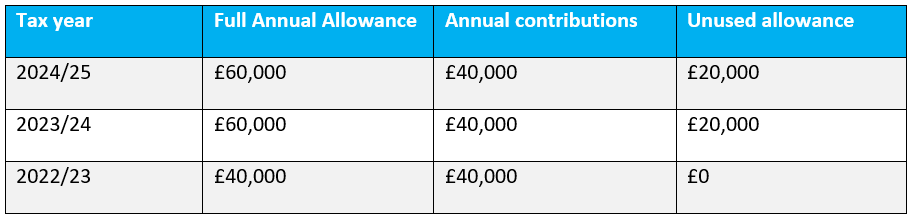
However, you can carry forward unused Annual Allowance from the previous three tax years. This may be especially useful, if you have surplus income or receive an unexpected windfall.

Let’s take a look at an example.

Assuming you have an Annual Allowance of £60,000 in 2025/26, you could carry forward your unused £40,000 allowance from the past three years and contribute up to £100,000 tax-efficiently this year.

As you can see, carry forward can be a valuable tax and retirement planning tool.

Get in touch

If you’d like help reviewing your pensions and taking control of your retirement savings, we can help.

Please email hello@bluewealth.co.uk or call us on 0117 332 0230.

Please note

The content of this newsletter is offered only for general informational and educational purposes. It is not offered as, and does not constitute, financial advice.

Blue Wealth Ltd is not responsible for the accuracy of the information contained within linked sites.

Blue Wealth Ltd is an appointed representative of Best Practice IFA Group Ltd, which is authorised and regulated by the Financial Conduct Authority.

Please do not act based on anything you might read in this article. All contents are based on our understanding of HMRC legislation, which is subject to change.

The Financial Conduct Authority does not regulate tax planning.

A pension is a long-term investment not normally accessible until 55 (57 from April 2028). The fund value may fluctuate and can go down, which would have an impact on the level of pension benefits available. Past performance is not a reliable indicator of future performance.

The tax implications of pension withdrawals will be based on your individual circumstances. Thresholds, percentage rates, and tax legislation may change in subsequent Finance Acts.

Workplace pensions are regulated by The Pension Regulator.

Approved by Best Practice IFA Group: 04/08/2025

Guide: Planning for a longer life: Wellbeing tips and financial management strategies

Average life expectancies have increased significantly in recent years, both in the UK and the rest of the world. While people living longer is always good news, it also brings new challenges for your health and, crucially, your finances.

Maintaining your physical and mental wellbeing over a longer life requires more than just good luck. It involves making intentional choices about your diet, exercise, mental health, and lifestyle. 

At the same time, increased longevity means your financial resources need to stretch further, and financial planning is an important part of ensuring you can enjoy later life without stress.

As well as practical wellbeing tips that could help you enjoy a longer retirement, this useful guide looks at how you might strengthen your financial security in the future. The guide explores some of the potential challenges that may arise, such as:

  • Living longer may mean you want to delay your retirement 
  • Rising life expectancy could mean it’s more important to plan for care
  • Estate planning strategies may need to change if you’re planning for a longer life. 

Download your copy here: Planning for a longer life: Wellbeing tips and financial management strategiesto find out how a longer life could affect your long-term plans. 

If you’d like to talk to us about planning for a longer life, please get in touch. 

Please note: This article is for general information only and does not constitute advice. The information is aimed at retail clients only.

Please do not act based on anything you might read in this article. All contents are based on our understanding of HMRC legislation, which is subject to change.

The Financial Conduct Authority does not regulate estate planning, cashflow planning, tax planning, trusts, Lasting Powers of Attorney, or will writing.

A pension is a long-term investment not normally accessible until 55 (57 from April 2028). The fund value may fluctuate and can go down, which would have an impact on the level of pension benefits available. Past performance is not a reliable indicator of future performance. 

The value of your investments (and any income from them) can go down as well as up and you may not get back the full amount you invested. Past performance is not a reliable indicator of future performance. 

Team update – We’re proud to announce that Blue Wealth has sponsored a rugby team

As you may have noticed, the Blue Wealth team loves sport, and we’re just as passionate about supporting the local community.

So, Rob has decided to combine the two and sponsor a rugby club.

A little bit about Frampton Cotterell Rugby Football Club (RFC)

Frampton Cotterell RFC is a well-established grassroots club on the outskirts of the city, about a 25-minute drive from our office.

It’s a real hub for rugby across all age groups and abilities. There are three senior teams, a ladies touch team, and a thriving minis and juniors section (from under 5s to under 18s).

The club is also a registered charity, which aims to promote community participation in healthy leisure activities, including rugby union and other sports. It champions community spirit and offers a warm welcome to all enthusiastic players.

Our sponsorship

Rob’s 10-year-old son is a devoted member of Frampton Cotterell RFC. So, the Blue Wealth team knows what a wonderful experience it offers young people in and around Bristol.

That’s why we’re delighted to sponsor the club.

We have helped fund 140 items of kit for 40 junior coaches, including t-shirts, shorts, heavy-duty winter coats, and more.


The role of a junior coach can be a thankless task. Rob says, “We’re all volunteers and give up a lot of time to help run the club, both on and off the field. It’s nice to be able to support the coaches with kit to show some appreciation”.

“We’re proud to be able to support the local community. With my involvement in the club, this is a cause close to home.

“Helping grassroots sport and any other local worthwhile causes will always be something we’re interested in. So, we’re proud to offer this sponsorship in addition to our charity incentive, which is our commitment to make a £50 donation to a good cause for every initial meeting that comes from a client recommendation.”

Get in touch

If you’d like to find out more about our charitable efforts or how we can support you with all your financial planning needs, we’d love to hear from you.

Please email hello@bluewealth.co.uk or call us on 0117 332 0230.

Please note

This article is for general information only and does not constitute advice. The information is aimed at retail clients only.

All information is correct at the time of writing and is subject to change in the future.

Giving back: The emotional and financial rewards of philanthropy

The Guardian recently reported that the tech mogul Bill Gates has vowed to give away most of his $200 billion fortune to support African health and education causes.

While you may not have a bank balance to rival that of Gates, giving back some of your accumulated wealth could benefit both your emotional and financial wellbeing.

What’s more, according to the BBC, an estimated 4 million fewer people in the UK are donating to charity compared to before the coronavirus pandemic, due in part to the ongoing cost of living crisis.

So, your help may be needed now more than ever before.

Keep reading to learn about the emotional and financial rewards of philanthropy and discover three practical steps for supporting a worthy cause.

Gain a sense of purpose and fulfilment

Personal success – be that in your career, business, or family life – may bring an immense sense of achievement and satisfaction.

Yet supporting causes that are close to your heart could provide further purpose and fulfilment.

Bill Gates is a huge advocate of philanthropy at all levels and encourages people to “judge yourselves not on your professional accomplishments alone but on how well you treated people a world away who have nothing in common with you but their humanity”.

Whether your passions lie in supporting a local community project or an international aid organisation, factoring philanthropy into your financial plan could allow you to make a meaningful contribution – while bolstering your emotional wellbeing.

Indeed, the University of Alabama at Birmingham has reported that engaging in acts of generosity activates the brain’s reward system, which triggers positive emotions and a sense of purpose.

Mitigate a potential Inheritance Tax bill

In her 2024 Autumn Statement, Chancellor Rachel Reeves announced several key changes to Inheritance Tax (IHT) rules. These included extending the freeze on IHT thresholds to 2030 and bringing pension wealth into a person’s estate for IHT purposes from April 2027.

As a result, the Office for Budget Responsibility has forecast that IHT receipts could double by 2030, rising from £7.5 billion in 2023/24 to £14.3 billion in 2029/30.

If you’re concerned about the potential IHT bill your loved ones may face, charitable giving could be a useful way to reduce your liability. This may be especially true if you have no dependants, or your children and wider family are financially independent.

Any gifts you make to registered charities are not usually included in IHT calculations. Moreover, if you donate at least 10% of your estate to charity, any IHT that is due will be charged at 36% rather than the standard rate of 40%.

So, perhaps it’s unsurprising that Professional Adviser has reported increased demand for estate planning advice since the Autumn Statement, with financial planners predicting a rise in charitable legacy giving.

Reduce your Income Tax liability

If you donate through Gift Aid, your chosen charity or community amateur sports club (CASC) could claim an extra 25p for every £1 you donate – at no cost to you.

What’s more, if you’re a higher- or additional-rate taxpayer in England, Wales, or Northern Ireland, you can claim back the difference between your tax rate and the basic tax rate (which the charity or CASC reclaims).

For example, if you pay additional-rate tax (45% in 2025/26), you could claim back the 25% difference between this and the basic rate (20% in 2025/26).

As such, with a small amount of admin, you could reduce your annual Income Tax liability.

To claim back the difference between the tax you’ve paid on your donation (your Income Tax rate) and what the charity will get back (usually, the 20% basic Income Tax rate), you’ll need to:

  • Complete a short Gift Aid declaration form provided by the charity or CASC
  • Submit a claim via your self-assessment tax return or by contacting HMRC to amend your tax code.

3 thoughtful ways to embrace philanthropy

1. Consider charitable donations as gifts

When a special occasion arises, such as a birthday or wedding, consider asking for charitable donations in your name rather than gifts.

Likewise, you might like to donate to a cause of your loved ones’ choosing when their special day rolls around.

2. Leave a charitable legacy in your will

In 2010, Bill Gates founded The Giving Pledge with the investor and philanthropist, Warren Buffett. This charitable campaign encourages wealthy individuals to give generously to charity, which many famous faces, such as Sir Elton John, have since chosen to do by leaving a legacy in their wills.

As mentioned above, this could be a valuable IHT planning tool.

There are several different ways to include charitable beneficiaries in your will, so you may benefit from speaking to a financial planner who can explain your options.

3. Give as you Earn

If you have an employer, find out whether they offer a “Give as you Earn” or “Payroll Giving” scheme.

This is a tax-efficient way to give to charity directly from your salary or your pension, as your donation is made before Income Tax is calculated.

It’s also a simple way to make regular contributions to worthy causes, which many charities rely on for funding their good work.

Get in touch

If you’d like help balancing your philanthropic interests with your long-term financial goals, we can help.

Please email hello@bluewealth.co.uk or call us on 0117 332 0230.

Please note

The content of this newsletter is offered only for general informational and educational purposes. It is not offered as, and does not constitute, financial advice.

Blue Wealth Ltd is not responsible for the accuracy of the information contained within linked sites.

Blue Wealth Ltd is an appointed representative of Best Practice IFA Group Ltd, which is authorised and regulated by the Financial Conduct Authority.

Please do not act based on anything you might read in this article. All contents are based on our understanding of HMRC legislation, which is subject to change.

The Financial Conduct Authority does not regulate estate planning, tax planning, or will writing.

A pension is a long-term investment not normally accessible until 55 (57 from April 2028). The fund value may fluctuate and can go down, which would have an impact on the level of pension benefits available. Past performance is not a reliable indicator of future performance.

The tax implications of pension withdrawals will be based on your individual circumstances. Thresholds, percentage rates, and tax legislation may change in subsequent Finance Acts.

Workplace pensions are regulated by The Pension Regulator.

Approved by Best Practice IFA Group: 1/7/25