Author: Rob Bowers

3 tips to manage your concern in an uncertain time

Since the start of 2022, you’ve probably noticed that global markets – and perhaps the value of your pension or investments – have been a little uncertain.

Over the last week or two, the ongoing situation in Ukraine has exacerbated this volatility.

It’s natural to feel nervous or worried when national or global events have a direct influence on your wealth. In recent weeks, there has been an almost perfect storm of events that have conspired to unnerve markets around the world, including:

  • The Russian invasion of Ukraine
  • Rising inflation across the developed world
  • Steep rises in the cost of energy for both domestic and business customers
  • Ongoing Covid concerns
  • Continuing global supply chain issues.

Read on to find out more about how markets have fared so far in 2022, and three helpful tips to manage your concern during a difficult period.

Markets have endured a volatile start to 2022

Since the turn of the year, markets have been noticeably jittery. Between 1 January and 26 February 2022, the US S&P 500 index fell by around 8%, while the German DAX fell by around 9% in the same period.

Despite falls in some markets, it’s interesting to note that, while the UK stock market may have been volatile in 2022 to date, the FTSE 100 is broadly at the same level it was at the start of 2022 – even with everything that’s happened on the global stage.

You can see this in the chart below, that shows the performance of the FTSE 100 from 1 January to 26 February 2022.

Source: London Stock Exchange

In simple terms, if you had invested in a FTSE 100 tracker, the value of your investment would be broadly the same at the end of February as it was at the start of January.

However, with experts predicting a protracted war in Ukraine alongside an inflation rate not seen for decades, it’s likely that a tricky few months lie ahead.

So, here are three tips that may help you manage any anxiety you have about your finances.

1. Try not to panic

Imagine the value of your home had fallen by 10%. What would you do?

Would you immediately panic, worry about potential further erosion of value, and sell your home straight away?

Or would you remain patient, trust that markets generally tend towards growth, and wait until prices recover?

It’s almost certain you’d take the second path. This is also a good way to think about the value of your pensions, ISAs, shares, and investments.

We only have to go back a couple of years to see this in action.

One of the immediate effects of Covid-19 arriving in the UK, and the first national lockdown, was that the UK stock market fell sharply. Between 21 February 2020 and 23 March 2020, the value of the FTSE 100 fell by just under a third, as the chart below shows.

Source: London Stock Exchange

Had you sold your investments at the bottom of the market, you’d likely have crystallised a significant loss.

However, had you remained patient, the FTSE 100 had recovered to its February 2020 level by the winter of 2021 – less than two years later.

Source: London Stock Exchange

The lesson here is that, over time, markets typically recover. You may have to remain patient, but cashing in equities after a market fall can simply turn a paper loss into an actual loss.

2. Don’t check the value of your portfolio every day

In periods of uncertainty, you may check the value of your investments more regularly than usual. It’s a perfectly natural reaction to volatility.

However, this often only increases your anxiety and worry and can magnify sharp moves in the markets.

For example, the FTSE 100 fell by 3.8% on 24 February – the day Russia invaded Ukraine – but rose by almost 4% the following day.

You also have to consider that it’s highly likely that your investments are diversified across sectors and countries. So, hearing a negative headline about the FTSE 100 on the BBC news won’t necessarily reflect what’s happened to the value of your own assets.

That’s because you’ll likely be invested in dozens of countries and hundreds of companies around the globe. Diversification helps to mitigate a fall in one area because it can be balanced by growth in another.

In a world of rolling 24-hour news, it can be hard to “drown out the noise”, but resisting the temptation to check the value of your assets every day can help you ride out periods of uncertainty.

3. Focus on your long-term goals

While you may be concerned about the short-term volatility of markets, it’s important to remain calm and stay focused on your goals.

Whenever you invest in equities, short-term volatility is something that you should expect and accept. Everything from the Budget to global geopolitics can affect what happens to markets around the world. On any given day or week, prices will fluctuate in the short term.

However, in the long term – and that’s what you’re likely to be investing for – markets tend to offer positive returns.

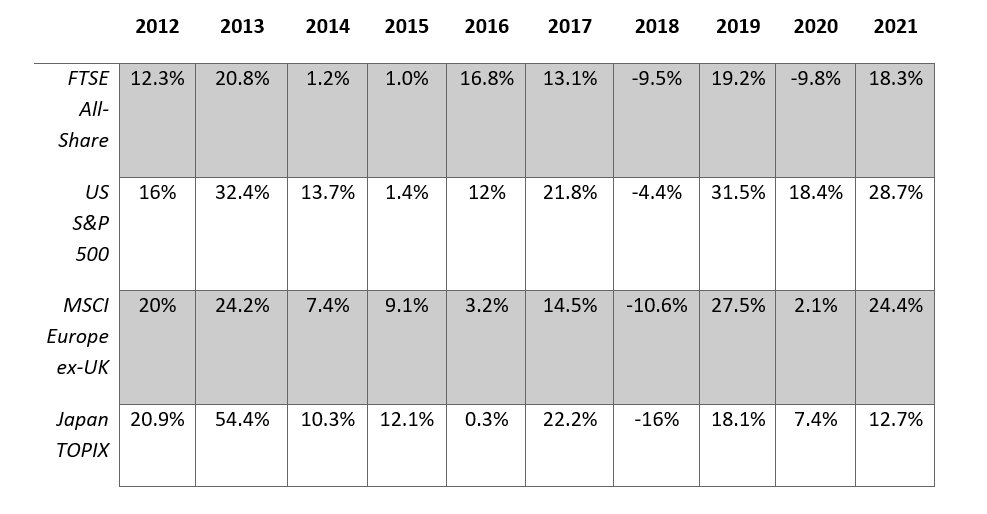
Here’s a useful summary of the annual return of some of the major stock indices over the 10 years to 2021. It shows that, with one or two exceptions, stock markets over the last decade have tended to produce positive annual returns – even in the light of Brexit, economic uncertainty, and Covid-19.

Of course, the value of your investment can go down as well as up and you may not get back the full amount you invested. Past performance is not a reliable indicator of future performance.

Source: JP Morgan, FTSE, MSCI, Refinitiv Datastream, Standard & Poor’s, TOPIX, J.P. Morgan Asset Management. All indices are total return in local currency, except for MSCI Asia ex-Japan and MSCI EM, which are in US dollars. Past performance is not a reliable indicator of current and future results. Data as of 31 January 2022.

If your long-term goals haven’t changed, it’s unlikely that your plans should.

Your goals are likely to be the same as they were a week or a month ago. We design our investment strategies with the long term in mind, and this naturally considers periods of both positive and negative returns.

We’re here to help

One of the ways we can help you achieve your goals is by acting as a “sounding board” during periods of instability. We’re here to help you avoid making knee-jerk decisions that can impact your long-term goals.

If you would like to chat to us about the current uncertainty, or you’d like to review your financial plan, please get in touch.

Please note

The value of your investment can go down as well as up and you may not get back the full amount you invested. Past performance is not a reliable indicator of future performance.

Blue Wealth – Charity Incentive

We’re excited to let you all know that we’re looking to launch our brand-new charity incentive to help raise money for a great cause. To start, we need your help.

What is our charity incentive?

We’re planning to make a £50 charitable donation for every initial meeting we have that comes from a client recommendation. Whether the meeting takes place in person or remotely (via Zoom, Teams, etc.), we’ll donate. There’s not even a requirement for them to become a client!

Simply put, if you recommend your friends, family or colleagues to us and we meet with them, we’ll make a £50 donation on your behalf.

How can you help?

First, we need to decide which worthy cause to support, and we want you to have your say. So, we’re conducting a poll of shortlisted charities that we believe all deserve our support.

This poll will be open for four weeks to allow everyone the opportunity to vote for the charity they’d like to see us support. You can vote for your chosen charity in the section below.

The shortlist

We’ve created a shortlist of charities that we think all deserve our support. The charities were selected from the results of our client survey, which many of our clients kindly completed.

To vote for the charity you want to see receive our support, please click on them below and select the “Vote” button. For more information on our shortlisted charities, please scroll further down.

St Peter’s Hospice

St Peter’s Hospice has been serving the community across the wider Bristol area since 1978. Every year they make a difference in the lives of thousands of patients and their families when it matters most.

Whether that is helping manage pain, offering bereavement support or providing relief from symptoms, the hospice team works 24/7 to support individuals and families as they navigate the challenges of living with a life-limiting illness.

Caring in Bristol

Caring in Bristol work in imaginative and creative ways with people experiencing or at risk of homelessness. They work with the public and community partners to bring about lasting change in Bristol and beyond.

They’re striving to create a society where everyone has a home, has hope, and is part of their community. Their team do not believe that homelessness is a simple issue with a simple solution. That’s why they work on several projects, helping people move away from the streets and preventing people from becoming homeless in the first place.

Bridge Care (Bridgemead)

Bridgemead is a residential and nursing home by the river in central Bath, caring for vulnerable older people and their families since 1992. They’re a home-from-home where residents and day club members are cherished and enabled to live fruitful lives in a loving Christian community.

Bridgemead has a team of caring, committed and qualified staff, helping their patients and guests feel as comfortable as possible. They offer a residential home, nursing care, a day club and respite care for those who need it.

Fareshare South West

With the rise in the cost of living, FareShare South West work against a backdrop of increasing food insecurity. They rely on donations and partnerships to source as much good quality surplus food as possible to supply to frontline charities across our region.

FareShare South West was formed in 2007 to help tackle the food poverty issue in the South West by redistributing surplus food across the region. Utilising quality, in date surplus food which would otherwise have gone to waste, they turn an environmental problem into a social solution.

BillyChip

The BillyChip Foundation registered charity was set up in 2018 to continue the legacy of Billy Abernethy-Hope, a 20-year-old ambulance driver from Bristol, who was the inspiration and idea behind the BillyChip.

The BillyChip can be given to those sleeping rough and/or homeless to allow them to purchase food and drink from takeaways and coffee shops. This helps people give money directly to those who need it, without fear of how it’s being spent.

Bristol Children’s Help Society

Bristol Children’s Help Society was established in 1884, and the first camp was held in Barton three years later. As such, it is one of the longest-running residential adventure camps for children in the country.

Through the continued efforts and support of the Harvey family, Barton continues to thrive to the present day. The camp is a fully accessible 101-bed residential centre available for hire.

Tobacco Factory Arts Trust

At Tobacco Factory Theatres, they provide a welcoming home for creative adventures and human connection. For incredible theatre and opportunities to learn and exchange ideas.

Their vision is to build an inclusive creative community rooted in their home in South Bristol. They believe their inspirational theatre will take people on creative adventures, nurture talent and provide life-changing opportunities.

Mothers For Mothers

Mothers For Mothers are a group of mothers, who have suffered and recovered from depression, anxiety or isolation during pregnancy or after the birth of a child.

They are women with lived experience who offer support, advice and information.


To vote for the charity you’d like to see us support please submit your vote below:


Once the poll has finished and we’ve calculated the results, we’ll be sure to update you with our winner.

Guide: 5 important lessons that Napoleon can teach you about growing your wealth

In 1793, a vast army of the French First Republic locked horns with a combined force of Royalists and their foreign allies at the port city of Toulon. It was in this battle that a young artillery officer caught the attention of his superiors, demonstrating not only a high level of organisational skill, but also tactical brilliance and the charisma needed to inspire his men.

This officer was, of course, Napoleon Bonaparte, and the Siege of Toulon would be the first major stepping stone in his long and glorious career.

When you’re looking for tips for growing your wealth, Napoleon isn’t the first person you might think of. Yet, his innovative and dynamic style of leadership can teach you many valuable lessons.

Read our latest guide to learn more about Napoleon and why he can teach you the importance of:

  1. Having reserves to protect against unexpected shocks
  2. Keeping an eye on inflation
  3. Understanding your attitude to risk
  4. Diversifying your assets
  5. Making an informed decision.

Download your copy of 5 lessons that Napoleon can teach you about your growing your wealth to learn more.

If you have any questions about investments or your financial plan, please contact us.

ESG investing – what does it really mean and is it good for my money?

Close up of senior hands giving small planet earth to a child against blurred green background.

We are more aware than ever of how the choices we make can affect the environment and social wellbeing of the planet. And this concern has filtered into decisions about how and where we invest our money.

This mounting interest in investing with consideration for both the environment and towards social responsibility has led to a huge number of new ESG investment funds coming to the market.

There are now more than 343 sustainable investment funds available to UK investors. And Morningstar reported that 169 new ESG funds were launched during the first quarter of 2021 alone.

But what does ESG actually mean, and how do you know which funds are doing good for the planet? More importantly, can these funds also provide good investment returns?

Read on to find out everything you need to know about ESG investing.

ESG stands for “environment, social, and governance”

While ESG is the most popular term for ethical investing, other terms you may come across include “SRI”, or socially responsible investing, “impact investing”, and “ethical screening”.

Multiple labels can make it difficult to know where to start. This article focuses on ESG, so to help clarify things, this is how it all breaks down in business practices:

E is for environment

Environmental factors include climate change, greenhouse gas emissions, carbon footprint, water usage, biodiversity, renewable energy, and pollution and waste. An example you might consider when assessing a company’s ESG rating is how much water they use in their manufacturing processes.

S is for social

Social factors include community relations and labour policies, product safety, supply chain sourcing, and social impact reporting. If you want to ensure you’re investing in a company that cares about their people, you may want to seek one that pays more than the minimum wage or seeks to hire a diverse work force.

G is for governance

Governance factors include shareholder rights, diversity, business ethics, and transparency. An example of good governance practice would be a company with a diverse board or one whose founder doesn’t hold majority voting rights.

Decide what you care about most

If you’re interested in making sure you invest in companies that care about the world, start by thinking about what it is that most matters to you.

For example, if climate change is your top concern, you might decide to avoid investing in companies that manufacture fossil fuels or rely on such fuels in their manufacturing.

However, if you’re more concerned about the way a business treats their people, you may want to focus your attention on the social side of ESG and invest in companies who pay their employees well and ensure good working conditions.

Risks to be aware of before you commit your funds to ESG

Although the Financial Conduct Authority are making moves to regulate and standardise ESG funds, there isn’t yet an agreed-upon standard for evaluating ESG performance.

Without a measure that companies must adhere to, inconsistencies in ESG portfolios and funds are inevitable. For example, most people would be surprised to learn that Shell is listed as an ESG company; this is because they invest heavily in researching green energy solutions.

To be sure your ESG funds align with your values, learn how the fund screens its underlying investments.

New ESG proposals should be announced by spring 2022

In late 2021, an advisory group, overseen by the FCA, met for the first time to discuss how ESG fund labelling could be improved. With new regulation likely to be implemented, you may wish to wait until the FCA have completed their research before you commit your funds to ESG.

Waiting until there’s a more widely accepted measure companies must attain to gain a recognised ESG rating may help you avoid the potential of buying an investment that doesn’t truly align with your values.

Is investing in ESG good for my money?

ESG companies can perform better than non-ESG companies. Although research is limited, studies that have been carried out tend to show that ESG investing as part of a well-balanced portfolio can reduce risk and generate competitive investment returns.

In fact, a study, conducted by Morningstar in 2020, found that the majority of ESG strategies performed better than non-ESG funds over one, three, five, and 10 years. And research published in the Financial Times found that “close to 6 out of 10 sustainable funds delivered higher returns than equivalent conventional funds over the past decade”.

Some believe that this may be because a company focusing on ESG requires strong leadership. Since ESG initiatives rely on long-term strategies, a leadership team who can realise long-term outcomes – while successfully running the core business – is a competitive strength.

Remember, ESG factors are no guarantee of investment performance. As with any stock market investment, you may still experience short-term volatility and there is always some risk involved.

One of the most important aspects for long-term investment performance is having a well-diversified portfolio across different asset classes and geographies.

There’s a lot to take into consideration when approaching ESG investment. We can help you understand all your options and explain how underlying companies stack up with their ESG business practices. We’ll go through all the information and find a suitable approach to building your investment portfolio based on your values and long-term financial goals.

Get in touch

If you’d like to learn more about ESG investing and how you can invest your money and do good for the world, please get in touch.

Email hello@bluewealth.co.uk or call us on 0117 332 0230.

The content of this newsletter is offered only for general informational and educational purposes. It is not offered as and does not constitute financial advice.

The value of your investment can go down as well as up and you may not get back the full amount you invested. Past performance is not a reliable indicator of future performance.

Blue Wealth Ltd is an appointed representative of Best Practice IFA Group Ltd, which is authorised and regulated by the Financial Conduct Authority.

Your guide to children and money

Setting out a financial plan and thinking about your long-term goals if you have a family is important. It can help ensure you reach your goals and create security for you and future generations.

For parents and grandparents, thinking about family when setting out your financial plan can help you protect the people that are most important to you and help you get a head start on milestones you may want to help loved ones with.

Perhaps you want your children to go to private school or leave behind an inheritance that will create later life financial security? By making family a core part of your financial plan, you’re more likely to turn these goals into a reality.

The first section of this guide looks at practical things you can do to create financial security, like writing a will or opening a savings account for a child, and answers some questions you may have, such as: should I create a trust to pass on wealth?

It’s not just about the financial support we’re able to offer family either. Passing on knowledge and experience can be crucial in creating long-term security for the next generation. The second part of this guide looks at how you can help children and grandchildren lay the foundations for financial security in adulthood.

Download a copy of Your Guide to Children and Money to learn more.

If you have any questions about the topics covered in the guide, or would like to discuss what you can do to improve the financial security of your family, please get in touch.

What is inflation and what does it mean for you and your wealth?

woman with shopping trolley buying food at supermarket

Following a sharp increase in the price of gas and electricity, inflation now stands at 4.2%, up from 3.1% in September.

It’s at its highest rate since November 2011 and stands 2.2% above the 2% rate that the Bank of England (BoE) aims for. This sharp rise in the cost of living is applying more pressure to households across the UK.

Read on to find out more about how inflation works, how it can affect your finances, and what you can do to prevent it from harming your wealth.

How inflation erodes your purchasing power

Inflation is a measure of the rate that prices are rising. Low levels of inflation are hard to detect over the long term, but price rises can have a big impact on how far your money will go.

Inflation means your money loses value over time. As an example, here’s how much bread you could buy with £1 over the past few decades:

  • 1970: £1 = 10 loaves of bread
  • 1980: £1 = 3 loaves of bread
  • 1990: £1 = 2 loaves of bread
  • 2020: £1 = 1 loaf of bread

Today, £1 can buy you far less bread than you’d have got in 1970. And, in another 10 years, it will buy even less. This is referred to as the “purchasing power” of your money.

Economic stagflation will reduce the purchasing power of money you save in the bank

Economic stagflation happens when slow economic growth occurs alongside high levels of inflation. This will affect the purchasing power of money you have saved in the bank.

One way to avoid this problem is to make sure your savings account pays more interest than, or at least matches, the rate of inflation. So, with inflation at 4.2%, ideally you want your savings in an account paying at least 4.2% interest.

This is easier said than done, however, as there are very few savings accounts paying high enough interest to make up the necessary difference.

Plus, if you have to pay tax on your savings interest, you’ll need an even higher rate of interest to keep pace with inflation.

Your income may not keep pace with inflation

If the money you earn remains stable or rises less than inflation, you’ll see a fall in the real value of your income because you’ll be able to buy less with what you make.

Some people will be lucky and see their income keep pace with inflation and rising prices. Lorry drivers, for example, will probably see an increase in their earning power because firms need to attract more drivers to fill the roles available and so will have to pay higher salaries.

A few things that you may have noticed cost more

Petrol

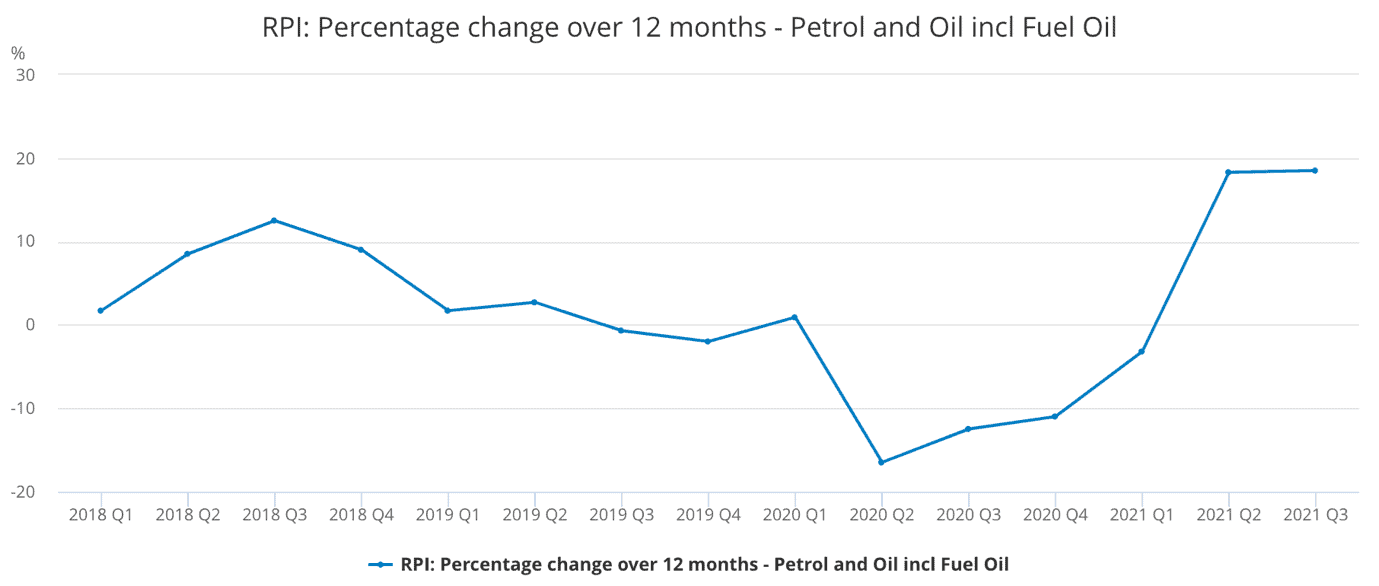
Although the autumn fuel crisis was short-lived, and you no longer need to queue to fill your car with petrol or diesel, prices are still high. In November, the RAC revealed that the average price of unleaded petrol was 146p a litre and diesel recently reached 150p a litre.

If you need to fill up a 55-litre family car with unleaded petrol, it will now cost more than £80.

RAC fuel spokesperson Simon Williams warned drivers to expect an “excruciatingly expensive winter”, and those on a low income or who use their car to travel to work every day will particularly feel the pinch.

Source: Office for National Statistics (ONS)

Heating bills

As we enter the colder months, the cost of heating our homes naturally increases. But this winter these costs are likely to hit some people far harder than usual.

There’s been plenty of press coverage about the rising price of gas and electricity. While the cost to suppliers has soared to unprecedented levels for a variety of complex global reasons, the effect is now being felt by consumers.

Several suppliers have gone bust, and their customers have been moved to another supplier, but many will now be on a more expensive tariff.

Even if your electricity supplier is still in business, chances are you’ll have noticed an increase in your bills or have had to increase your monthly direct debit in line with rising prices.

Crisps and snacks

Data from Kantar showed that the cost of savoury snacks, such as Pringles, Doritos, and Hula Hoops, rose 7.6% in the 12 weeks to the end of October.

As well as these moreish snacks, the price of canned cola, potato crisps and cat food all increased by almost 6% or more.

Retailers have had to resort to price hikes in an attempt to offset higher costs of transport, fuel, stock and wages.

Steps you can take to protect your finances from inflation

While you can’t stop inflation from happening, your personal rate of inflation depends on how you spend your money. It won’t necessarily match the official rate of inflation.

Calculate your personal inflation rate

You can calculate your personal inflation rate by tracking your own spending and calculating the percentage change from one year to the next.

If you keep a household budget, you may be able to work this out easily by looking back to see what you were spending this time last year versus what you have spent this year.

Invest your cash

With your wealth and investments, investing wisely in the stock market can give your money the best opportunity to beat inflation and grow.

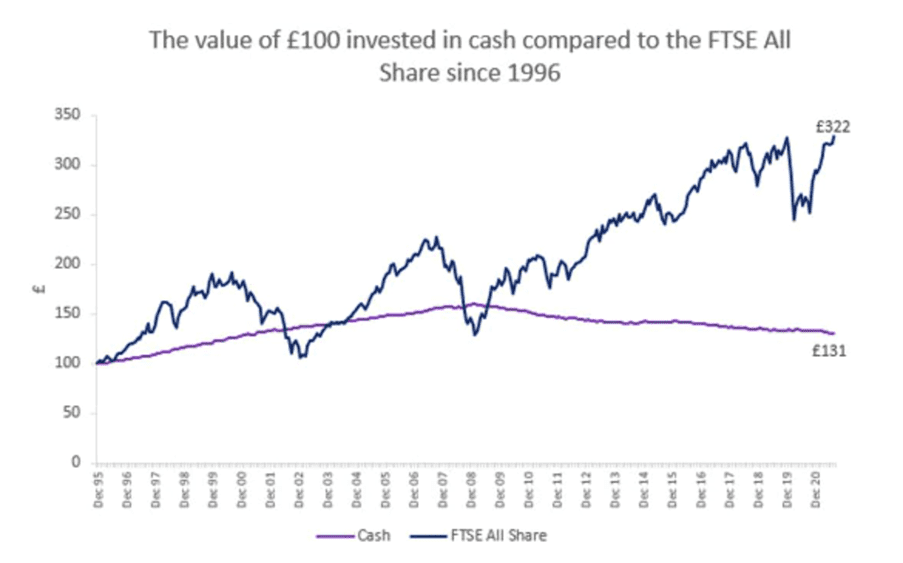
Investing in the stock market comes with some risk, but history shows that, over the long term, equity investments tend to outperform cash and produce an above-inflation return.

To illustrate the power of investing in the stock market, the chart below illustrates how £100 invested in cash compared to the FTSE 100 index.

Source: Refinitiv Datastream (total return assumes that all earnings and dividends are reinvested.)

Protect your money in a “safe haven”

During times of inflation, some people prefer to put their money in so-called “safe havens”.

“Safe havens” are assets that you’d expect to remain popular over decades because the supply is limited. “Safe havens” can include rare or unique items such as classic cars, works of art, or commodities such as gold or platinum.

Talk to a financial planner

For the best chance of protecting your wealth and finances against inflation, talk to a financial planner. They will have a deep understanding of the problems you face and the different ways you can mitigate the issues based on your own financial circumstances.

Get in touch

If you’re concerned about the effects of inflation and want to find out how you can protect your wealth, we can help.

Email hello@bluewealth.co.uk or call us on 0117 332 0230.

The content of this newsletter is offered only for general informational and educational purposes. It is not offered as and does not constitute financial advice.

The value of your investment can go down as well as up and you may not get back the full amount you invested. Past performance is not a reliable indicator of future performance.

Blue Wealth Ltd is an appointed representative of Best Practice IFA Group Ltd which is authorised and regulated by the Financial Conduct Authority.

Everything you need to know about the 2021 Autumn Budget

British chancellor, Rishi Sunak, leaving 11 Downing Street

“Employment is up, investment is growing, public services are improving, the public finances are stabilising, and wages are rising.” This is the backdrop against which Rishi Sunak presented the 2021 Autumn Budget.

Promising “a stronger economy for the British people”, the chancellor outlined his taxation and spending proposals. Here’s a summary of the key points and what they mean for you.

Firstly, though, a reminder of two important tax changes that have already been unveiled.

2 important announcements already made

Back in September, the prime minister made two headline-grabbing tax announcements.

From April 2022, National Insurance rates for both employees and the self-employed will rise by 1.25 percentage points across earnings bands. Millions of employees and many employers will see their National Insurance contributions increase, raising around £12 billion a year for the Treasury.

This rise will be rebranded as a “Health and Social Care Levy” from April 2023, when National Insurance rates will revert to their current levels.

From April 2023, anyone who is working beyond the State Pension Age will be asked to pay 1.25% on their earned income for the first time.

In addition, Dividend Tax rates will also rise 1.25 percentage points from April 2022. The £2,000 allowance will remain, but anyone earning more than £2,000 in dividends will pay a higher rate of tax.

The economy is recovering quicker than expected

The chancellor began his speech by outlining Office for Budget Responsibility (OBR) data that expects the economy to return to pre-Covid levels at the start of 2022.

The OBR has revised their growth estimate for the UK economy from 4% to 6.5% in 2021, then forecasts 6% growth in 2022, followed by 2.1%, 1.3% and 1.6% over the next three years. They also revised down the effect of Covid “scarring” on the economy from 3% to 2%.

Sunak also said that he expects inflation to average 4% over the next year. He highlighted two reasons for this:

  • As economies around the world reopen, demand for goods has increased more quickly than supply chains can meet
  • The pressures caused by supply chains and energy prices will take months to ease.

“I am in regular communication with finance ministers around the world and it’s clear these are shared global problems, neither unique to the UK, nor possible for us to address on our own,” he added.

The improving fiscal position also means that the chancellor forecasts a return to spending 0.7% of GDP on foreign aid before the end of this parliament.

The chancellor also confirmed that every government department will get a real terms rise in spending each year.

Tax

While the main tax announcements have already been made, the chancellor announced several reforms:

  • A new 4% levy on property developers with profits of more than £25 million, to help fund a £5 billion fund to remove unsafe cladding
  • A reduction in air passenger duty for domestic flights between UK airports from April 2023. 9 million passengers will see their duty cut by half, boosting regional airports. There will also be an increase in duty for long-haul flights of more than 5,500 miles
  • The bank surcharge, levied on bank profits, will reduce from 8% to 3% from April 2023. The chancellor said that this should help bolster London’s competitiveness as a global financial centre after Brexit
  • The planned rise in fuel duty has been cancelled. The average car driver now saves £1,900 a year because of a 12-year freeze in fuel duty.

In a tiny technical change, the deadline for residents to report and pay Capital Gains Tax after selling UK residential property will increase from 30 days after the completion date to 60 days.

The chancellor also set out plans to reform alcohol duty, made possible because the UK has now left the European Union.

Arguing that the tax, first introduced in 1643 to pay for the Civil War is “a mess”, the main duty rates will reduce from 15 to 6 around the general principle of “the stronger the drink, the higher the rate”.

  • Small Brewers Relief will be extended to cider makers and other producers making drinks less than 8.5% ABV
  • The duty premium on sparkling wines will end, so drinkers will pay the same duty on prosecco and English and Welsh sparkling wine as on still wines
  • A new “draft relief” will see a lower duty rate on draft beer and cider. Set to benefit community pubs, this cuts duty by 5% and represents the biggest cut to cider duty since 1923 and the biggest cut to beer duty for 50 years.

Shares in pub chain JD Wetherspoon jumped 5.5% on the news.

Finally, the chancellor announced a total of £7 billion of cuts to business rates. The retail, hospitality, and leisure sectors will benefit from a 50% business rates cut for one year, enabling businesses to claim a discount on their bill up to £110,000. This will benefit cinemas, music venues and so on.

Sunak concluded his speech by confirming that “my goal is to reduce taxes” calling it “my mission for the remainder of this parliament”.

Despite this, the OBR has confirmed that the tax burden is set to rise from 33.5% of GDP recorded before the pandemic in 2019/20 to 36.2% of GDP by 2026/27.

This is the highest level since late in Clement Attlee’s post-war Labour government in the early 1950s, when the economy was struggling after the economic shock of the second world war.

Housing

To boost the building of new homes, the chancellor announced an £11.5 billion fund to build up to 180,000 new affordable homes. He described it as “the largest cash investment in a decade, 20% more than the previous programme”.

Sunak also confirmed a £1.8 billion brownfield fund, which will help “unlock 1 million new homes”.

Savings

The chancellor announced the creation of a new National Savings & Investment (NS&I) Green Savings Bond.

These were made available to customers via NS&I on 22 October and will be on sale for a minimum of three months. These three-year fixed-term savings products will pay an interest rate of 0.65% and customers can invest between £100 and £100,000.

As with all NS&I products, the Green Savings Bonds come with a HM Treasury-backed 100% guarantee.

The Treasury also announced that the Individual Savings Account (ISA) annual subscription limit will remain at £20,000 in 2022/23. The annual subscription limit for Junior ISAs and Child Trust Funds for 2022/23 will be maintained at £9,000.

Changes to the National Living Wage and Universal Credit

The National Living Wage (the minimum wage) for over-23s will increase from £8.91 to £9.50 an hour. This represents an increase of £1,000 a year for a full-time worker and more than 2 million people will benefit.

“To make sure work pays”, the chancellor announced a change to the Universal Credit taper from 63p to 55p and promised to introduce this before December 1. He will also increase work allowances by £500 a year to help working families with the cost of living.

This enables more working families on the lowest incomes but working to keep more of their earnings. Sunak says that a single mother of two renting, and working full-time on the National Living Wage, will be better off by around £1,200.

Other spending announcements

Sunak unveiled a raft of spending commitments in areas from education to health.

  • £21 billion on roads and £46 billion on railways
  • A guarantee to spend £5.7 billion for London-style transport systems across city regions
  • Spending on cycling infrastructure of more than £5 billion
  • 20,000 new police officers, an extra £2.2 billion for courts and rehab facilities, and £3.8 billion for prison-building
  • £300 million towards A Start for Life, supporting new parents, and £150 million for Early Years training and holiday programmes
  • At least 100 places will benefit from the “levelling up” fund. The first round of successful bids to the fund, worth £1.7 billion, have been announced, including projects in Stoke-on-Trent, Bury and Burnley
  • £500 million in funding to help people back into work in “the most wide-ranging skills agenda this country has seen in decades”. This includes careers help for older workers and builds on extra funding for apprenticeships and traineeships already announced in the spring.

Sunak also announced £205 million to transform grass-roots sport by funding up to 8,000 community sports pitches. He also committed £11 million towards the FA bid to host the 2030 World Cup.

There will also be £2 million for a new Beatles attraction on the Liverpool waterfront.

Get in touch

If you have any questions about how the Autumn Budget will affect you and your finances, please get in touch.

Please note

This article is for information only. Please do not act based on anything you might read in this article. All contents are based on our understanding of HMRC legislation, which is subject to change.

3 scary financial scams to be aware of and how to protect yourself and others

Mature man holding a piggy bank, looking scared and trying to protect his savings from being stolen

Technology has made it easier than ever for scammers to target victims. And their tactics are growing ever-more sophisticated. Even people who research firms and deem them to be genuine have found themselves duped out of their life’s savings.

One of the most recent scams to make the headlines is “push payment” fraud. This is when victims are tricked into transferring money to a fraudster in the belief they are calling from the victim’s bank or the police.

Last year, scammers managed to steal £479 million from 150,000 victims this way – an increase of 22% on the previous year.

And that’s not all.

In the first quarter of the 2021/2022 financial year, the Financial Ombudsman Service saw a frightening 66% rise in fraud and scam complaints. There have so far been 5,025 cases in 2021. During the same period last year, they received 3,028 cases.

Even if you’re financially savvy, a scammer can catch you at a vulnerable time and persuade you to part with your cash. So, here are a few things to watch out for and advice about how you can protect yourself from letting a scammer get away with your hard-earned money.

3 common financial scams you need to be aware of

More than three cases of fraud are recorded every five minutes, so it’s wise to know what to watch out for.

While there are multiple ways scammers might target your wealth, these are three of the most common financial scams to be aware of.

1. Early pension release – Watch out for scammers using phrases like “pension liberation” or “pension loan”

Pensions are often one of your largest assets, but they are locked away until you reach a certain age. At the moment, most people are allowed to access their pension at age 55 without penalty. In 2028, this will increase to age 57.

You may wish to retire early or be tempted to boost your income by accessing your pension early. But beware of scammers attempting to capitalise on your temptation.

You’re only allowed to access your pension savings before a specific retirement age under exceptional circumstances. For example, if you are diagnosed with a terminal illness, you may be able to withdraw funds from your pension without penalty.

If someone tries to persuade you it’s possible to get money out of your pension early, don’t fall for it. If you succumb, you could face a large tax bill and, worse still, lose all your pension savings.

2. Share, bond, and “boiler room” scams – Watch out for cold-callers offering an opportunity to invest in shares or bonds

Fraudsters operate out of so-called “boiler rooms” to cold-call potential investors.

If you’re unfortunate enough to receive one of these fraudulent cold-calls, you will usually be offered shares or bonds that are worthless, overpriced, or may not exist at all.

Fraudsters will use sophisticated, high-pressure tactics to try to get you to invest.

As well as cold-calling their potential victims, they’ll sometimes use online ads or adverts in newspapers or magazines to encourage potential investors to call them directly.

3. Overseas property and crop scams – watch out if someone offers you a high-return, low-risk investment opportunity

If someone offers you the opportunity to invest in overseas property or crops, they will often encourage you to buy a plot of land, claiming it will be used to build property or for agricultural commodities.

Investment periods are long, often around five years. This means it can take some time before investors realise they have been scammed and their money is long gone.

These fraudsters will also deploy high-pressure tactics to encourage you to make a quick decision.

How to protect your money from financial fraudsters

First, arm yourself with knowledge about how scammers and fraudsters operate. Reading this article is a good start, but it’s also a good idea to share your learning with others.

A five-minute conversation could help prevent fraud

Talk to your friends and family about what they need to look out for. A friendly warning from a trusted friend could be all it takes to help protect someone you know.

Useful anti-fraud checklists

If a stranger calls or emails asking for personal details, ask yourself these questions. It could be all it takes to help you identify a fraudster and protect your money.

5 ways to spot a fraudulent call

  1. Were you expecting the phone call, or did it arrive out of the blue?
  2. Are they asking you to confirm sensitive details such as your full name, address, or banking details?
  3. Are they pressing you for an instant or fast response?
  4. Are they asking you for money?
  5. Is the caller avoiding having to use the actual name of your bank or utilities company?

5 ways to spot a fraudulent email

  1. Is the greeting generic or impersonal?
  2. Does the branding on the email match the company or government website?
  3. If you’ve received a suspicious email from your bank or other company, has it come from an odd email address?
  4. Are you being asked to change your password even though you haven’t received a request to do so?
  5. Is the formatting strange or are there spelling mistakes?

If you’re concerned that you may have been the target of fraud, we’re here to provide information and lend support.

Get in touch

If you’ve been approached and are worried it may be a scam, please get in touch. Please email hello@bluewealth.co.uk or call us on 0117 332 0230.

National Insurance and Dividend Tax rise as government suspends State Pension triple lock

British prime minister, Boris Johnson

This week, the government has made two major policy announcements that are likely to directly affect your finances.

A much-anticipated National Insurance rise will result in an increased burden on workers including, for the first time, those above State Pension Age.

In addition, the government has suspended the State Pension triple lock, meaning that pensioners will receive a much more modest increase than anticipated.

Read on for everything you need to know about these policy changes.

The new “health and social care levy” will push up National Insurance bills by 1.25%

Despite a clear commitment in their last election manifesto not to raise taxes, the government has unveiled a 1.25% hike in National Insurance contributions from April 2022. This is to raise additional revenue to fund health and social care.

From April 2022, employees will begin to pay the levy through an increase in their National Insurance contributions. The 1.25% increase will also be levied on employers.

This additional contribution will then become a “health and social care levy” from April 2023 and will appear as a separate deduction on payslips.

According to the Guardian, an individual earning £50,000 can expect to see their National Insurance contributions rise from £4,852 to £5,357 each tax year, equivalent to a £505 tax increase. If you earn a salary of £100,000, you can expect your annual contributions to rise by £1,131.

The government says that, for the next three years, the tax increase will generate an additional £12 billion a year for health and social care. Of this, they have earmarked £5.4 billion over the period specifically for social care, with another £8.9 billion going on what is termed a “health-based Covid response”.

Once the NHS backlog starts to clear, ministers say that more of the money will go to social care, although how this will happen has not been set out.

Extra money will also be sent from Westminster to Scotland, Wales, and Northern Ireland, which the prime minister said would receive more money than they paid in, as a “union dividend”.

A million working pensioners will pay National Insurance for the first time

In another radical reform, around 1 million working pensioners will pay National Insurance contributions on their earnings from 2023.

Under the current system, taxpayers stop making National Insurance contributions when they reach 66, the point at which the State Pension kicks in.

It will be the first time that a government has asked pensioners to pay, with contributions starting at a rate of 1.25% in April 2023.

The Telegraph reports that a working pensioner earning £60,000 a year will go from paying nothing to paying £630 a year in National Insurance on top of Income Tax.

The government has proposed a cap on lifetime social care costs

Currently in England, if people have assets worth more than £23,250 then they must pay for their social care and there is no cap on the costs.

Under the new system, anyone with assets below £20,000 will not have to pay anything towards their care. Those with assets from £20,000 to £100,000 and above will have to contribute, on a sliding scale. This depends on contributions from local authorities, which deliver much of social care.

People in this bracket will not contribute more than 20% of their assets each year and, once their assets are worth less than £20,000, they would pay nothing more. However, they might still contribute from any income they receive.

Those with assets above the £100,000 threshold must meet all fees until the value of their assets fall below this amount.

Boris Johnson also announced a lifetime social care “cap” of £86,000, meaning that no individual will be asked to pay more than this sum for care in their lifetime.

This new means test system and the £86,000 cap will come into force in October 2023.

Dividend Tax is set to rise from April 2022

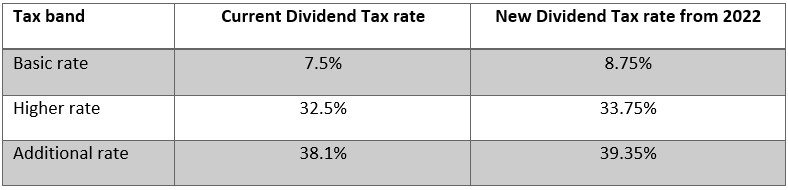
Alongside the National Insurance rise, Dividend Tax rates will also increase by 1.25% from April 2022. This change will mostly affect investors and business owners.

If you take home more than £2,000 a year in dividends, you will face a slightly higher bill regardless of your Income Tax band.

For example, if you’re a basic-rate taxpayer receiving £3,000 in dividends then you will pay Dividend Tax on £1,000. The government’s proposed changes mean that your bill will rise from £75 to £87.50.

Alternatively, if you’re a higher-rate taxpayer taking £10,000 in dividend payments then you would pay 33.75% on £8,000 of dividends. This would result in a Dividend Tax bill of £2,700, up £100 from the current system.

The government will suspend the State Pension triple lock for one year

In a move designed to save the government around £8 billion a year, work and pensions secretary, Thérèse Coffey, broke a second manifesto commitment by announcing that she was suspending the State Pension triple lock for one year.

She told the House of Commons that sticking to the triple lock – which promises that the State Pension will rise by the highest of inflation, earnings, or 2.5% – would be unfair, given that wages were increasing at a rate of well over 8% a year.

The distortion to national average earnings has been caused by the pandemic, as earnings fell at the start of the first lockdown before rising sharply as the furlough scheme ended. Had the government stuck to its commitment, pensioners would have expected an increase of between 8% and 9%.

Instead, the State Pension will rise more modestly in 2022 – either by 2.5% or price inflation. All eyes will now be on September’s inflation figure (announced in October) to determine how much the State Pension will rise next April.

Get in touch

If you have any questions about how the National Insurance increase, Dividend Tax rise, or triple lock suspension will affect you and your finances, please get in touch.

Guide: Leaving an inheritance vs gifting during your lifetime

Have you thought about how you’ll pass wealth on to those who are important to you? Traditionally, this has been done through inheritance, but it’s becoming more common to gift during your lifetime.

Our latest guide explains why more families are choosing to gift during their lifetime and the pros and cons of each option. Whichever option you decide is right for you, our guide will enable you to fully understand your situation and make sure your wishes are carried out, and will explain everything from writing a will to calculating the long-term impact of gifting.

It can be difficult to think about how you’ll pass on wealth to loved ones, but it’s important to set out a plan.

Download Leaving an inheritance vs gifting during your lifetime to discover the steps you should take.

If you have any questions about passing on wealth, please contact us.