Author: admin

Guide: How to plan for a 100-year life

The number of people celebrating their 100th birthday in the UK is on the rise. As life expectancy continues to increase, it is more important than ever to plan financially for a 100-year life.

According to the Office for National Statistics (ONS), there were 16,600 centenarians in 2024 – double the number in 2004 (21 October 2025).

Among those marking the milestone this year is the renowned natural historian Sir David Attenborough. The broadcaster turned 100 on 8 May, and he continues to share his passion for nature with the world.

Attenborough shows that entering later life doesn’t have to mean taking a step back. You could still embrace new experiences and create a life you love.

However, planning for a 100-year life often raises important questions about how to arrange your finances to secure the life you want, including how to ensure you have “enough” and what strategies are appropriate for you.

This guide explores some of the steps you might take to plan for a 100-year life.

Download your copy here: How to plan for a 100-year life

If you have any questions about planning for your later years, please get in touch.

Please note: This guide is for general information only and does not constitute advice. The information is aimed at individuals only.

All information is correct at the time of writing (April 2026) and is subject to change in the future.

Team update: Join us in congratulating Tom on passing his probation

Back in November, we introduced you to the newest member of our team, Tom Fraser.

We’re delighted to announce that Tom has successfully passed his probationary period at Blue Wealth.

Here’s what Tom told us about his role at the firm and plans for the future.

How long have you worked at Blue Wealth and what has been your career journey so far?

I joined Blue Wealth in October 2025, so it’s been seven months now.

I’ve worked in financial services since graduating Swansea University in 2019, and I decided to focus on paraplanning a few years ago. I’m keen to build a long-term career in the financial planning profession.

Since joining the firm, I’ve been learning a lot on the job, getting stuck in, while also working towards Chartered status.

How has your role changed since passing your probation?

Although my title hasn’t changed, I’m taking on more responsibility since passing probation.

I’m more involved in research and report preparation now, and I’ve started to develop a better understanding of processes from start to finish.

I am involved in more complicated financial planning solutions and products. I’m also becoming better able to support the team and advisers, which I really enjoy.

How does this promotion fit with your long-term career plans?

My main goal is to qualify as a fully Chartered paraplanner and build a strong technical foundation over the next couple of years. From there, I’d like to continue developing within financial planning, learning as much as I can and gaining solid experience.

What do you like best about your new role, and what aspects will challenge you to learn and develop?

I really enjoy the research side of the role and knowing that the work I’m doing contributes to helping our clients achieve their long-term goals. Being part of a small team is also great, as you get exposure to different areas and can learn quickly.

The most challenging part is probably building up my technical knowledge and working towards the diploma at the same time, but it’s a good challenge and something I’m motivated to keep improving on.

Get in touch

If you’d like to learn more about the Blue Wealth team and how we can support you with all your financial planning needs, we’d love to hear from you.

To find out more, please email hello@bluewealth.co.uk or call us on 0117-332 0230.

Please note

The content of this newsletter is offered only for general informational and educational purposes. It is not offered as, and does not constitute, financial advice.

3 important tax changes coming in April 2027 that you need to know about

It’s never too early to start preparing for the next tax year. This is especially true now, as several important tax changes are due to take effect from 6 April 2027.

These reforms could significantly affect your long-term financial plan, particularly your pensions, savings, and estate plans.

Taking the initiative and preparing for these changes early could help you keep your wealth as tax-efficient as possible and avoid unnecessary costs.

However, recent research suggests that public awareness of planned tax changes is low. Pensions Age reveals that 89% of UK adults have little or no awareness of the upcoming reform of Inheritance Tax (IHT) rules regarding pensions.

Keep reading to learn about three important tax reforms coming in 2027 and find out how we can help you prepare.

1. Most unused pensions will no longer be exempt from Inheritance Tax

When you pass away, your beneficiaries may have to pay IHT on your estate if its value exceeds certain thresholds.

You can pass on up to £325,000 without triggering an IHT charge. You may be entitled to an additional £175,000 IHT-free allowance if you leave your home to a direct descendant, such as a child or grandchild. Assets you pass to a spouse or civil partner are generally exempt from IHT, regardless of their value.

Any portion of your estate that exceeds these thresholds is subject to IHT, and the standard rate is 40%.

Currently, pensions normally sit outside your estate for IHT purposes. As such, they offer an effective way to pass wealth on to your loved ones tax-efficiently.

However, from 6 April 2027, most unused pension wealth will no longer be exempt from IHT. This could mean that your family is more likely to face an IHT bill or that the amount payable increases.

Indeed, the UK government estimates that by 2027/28, 10,500 estates will have an IHT liability where previously they would not have. Moreover, the average IHT bill is expected to increase by £34,000.

As such, if your estate plan centres on using your pension as a tax-efficient wealth transfer tool, you might benefit from speaking to a financial planner who can help you review your options.

2. The annual Cash ISA allowance will be reduced

ISAs are a valuable way to save and invest tax-efficiently because any interest or investment returns you earn are free from Income Tax and Capital Gains Tax.

In the 2026/27 tax year, you can contribute up to £20,000 across all your ISA accounts. You can choose how to split this, although Lifetime ISAs have an annual subscription limit of £4,000 up to the age of 50.

For example, you could put £10,000 in a Cash ISA and £10,000 in a Stocks and Shares ISA, or you might choose to put the full £20,000 into a single account.

This is set to change for some people from April 2027.

In her 2025 Autumn Budget, Chancellor Rachel Reeves confirmed that while the total ISA limit will remain at £20,000, the Cash ISA limit will be reduced to £12,000 each tax year for individuals under 65.

This could mean that more of your savings are exposed to Income Tax. If you’re a higher- or additional-rate taxpayer, this may have a significant impact on your annual tax bill.

3. Property and savings tax rates will increase

From 6 April 2027, Income Tax rates on interest earned from savings held outside an ISA that exceed your Personal Savings Allowance and property rental income will increase by two percentage points.

The new rates will be:

  • 22% for the basic rate
  • 42% for the higher rate
  • 47% for the additional rate.

This change could mean that more of your savings interest is subject to Income Tax, increasing your overall tax burden – especially if you’re a higher earner with multiple assets. As a result, you might want to reconsider relying on cash savings as a tax-efficient strategy for building wealth.

If you’re a landlord, higher taxes on rental income could reduce net returns, making your rental properties less profitable.

We can help you prepare for these changes now

Seeking professional advice and preparing early for these upcoming changes could ensure you manage your wealth as tax-efficiently as possible and keep your financial plans on track.

We can help by reviewing your pensions, savings, and investments to assess how the planned reforms could affect you.

By modelling different scenarios – such as how much IHT your estate might face under current and future rules – our financial planners can identify tax-efficient adjustments that could mitigate the potential impact of the changes. For example, you might want to give away more of your wealth during your lifetime to make use of annual IHT gifting allowances and reduce the size of your estate.

Acting now ensures you have plenty of time to structure your savings and investments strategically ahead of April 2027.

Get in touch

If you’d like help reviewing and adjusting your financial plan in preparation for the tax changes planned for April 2027, we’d love to hear from you.

To find out more, please email hello@bluewealth.co.uk or call us on 0117-332 0230.

Please note

The content of this newsletter is offered only for general informational and educational purposes. It is not offered as, and does not constitute, financial advice.

Blue Wealth Ltd is not responsible for the accuracy of the information contained within linked sites.

Please do not act based on anything you might read in this article. All contents are based on our understanding of HMRC legislation, which is subject to change.

The Financial Conduct Authority does not regulate estate planning, cashflow planning, or tax planning.

A pension is a long-term investment not normally accessible until 55 (57 from April 2028). The fund value may fluctuate and can go down, which would have an impact on the level of pension benefits available. Past performance is not a reliable indicator of future performance.

The tax implications of pension withdrawals will be based on your individual circumstances. Thresholds, percentage rates, and tax legislation may change in subsequent Finance Acts.

The value of your investments (and any income from them) can go down as well as up and you may not get back the full amount you invested. Past performance is not a reliable indicator of future performance.

Investments should be considered over the longer term and should fit in with your overall attitude to risk and financial circumstances.

Approved by Best Practice on: 15/5/2026

Guide: 7 key allowances you might want to use before the end of the 2025/26 tax year

The new tax year will start on 6 April 2026, and many of your important allowances and exemptions will reset. Checking whether you could use these valuable allowances before the end of the 2025/26 tax year on 5 April 2026 might help your money go further.

Before you make any decisions, ensure that you understand which allowances fit into your financial plan and suit your goals. If you have any questions, please contact us.

Read this guide to discover seven allowances and exemptions you may want to make the most of before the end of the current tax year, including:

  1. ISA allowance
  2. Junior ISA allowance
  3. Dividend Allowance
  4. Capital Gains Tax Annual Exempt Amount
  5. Marriage Allowance
  6. Pension Annual Allowance
  7. Inheritance Tax annual exemption 

Download your copy here: 7 key allowances you might want to use before the end of the 2025/26 tax year

Please get in touch if you’d like to speak to us about your allowances for the 2025/26 tax year and beyond. 

Please note: This guide is for general information only and does not constitute advice. The information is aimed at retail clients only.

Please do not act based on anything you might read in this guide. All contents are based on our understanding of HMRC legislation, which is subject to change.

Team update: Rob’s New Year family skiing trip to France

We hope you’ve all enjoyed a break over the festive season and that 2026 is off to a positive start.

This month we’re catching up with Rob to find out all about his family skiing trip to France over new year.

An exhausting but enjoyable week skiing as a family in France

After a busy Christmas, Rob and his family headed to the airport for their annual skiing trip. It’s a tradition they all love and look forward to each year.

New year is one of the busiest times to travel and it was pretty hectic when they landed at Geneva Airport, but otherwise the trip went smoothly.

Rob, his wife Deb, and their children, Jasper (age 11) and Piper (age 8), arrived tired but excited at their self-catering accommodation in Avoriaz, France. While the apartment was far from deluxe, the location was ideal.

Avoriaz offers access to the huge Portes du Soleil area, which generally boasts high-altitude snow and car-free slopes that are perfect for families.

Unfortunately, the snow wasn’t the freshest, but Rob said the stunning blue skies made up for it.


This was the first year the kids didn’t go to ski school, so the family got to spend the whole week on the slopes together.

Rob said, “Anybody who’s been skiing with young children will tell you that it’s not a relaxing holiday, especially at the busiest time of year.

It was a fantastic family trip though, even if I spent most of it chasing an 8- and 11-year-old down slopes, as they are considerably better skiers than me!”

One aspect of the trip went down less well with the Bowers family – the food. Rob isn’t a huge fan of French cuisine and the kids – being kids – are a little fussy too. Fortunately, Deb was happy; she loved the tartiflette (a creamy oven bake of potatoes, cheese, cream, bacon, and onions) that was served up in the mountains.

A highlight of the stay was the New Year’s Eve celebrations. There were fireworks and DJs playing music in the centre of the village.

Rob said, “The atmosphere was great and we just about managed to keep the kids awake until midnight!”

Get in touch

If you’d like to know more about the Blue Wealth team and how we can help you with all your financial planning needs in 2026 and beyond, we’d love to hear from you.

Please get in touch via email at hello@bluewealth.co.uk or call us on 0117 332 0230.

Please note

The content of this newsletter is offered only for general informational and educational purposes. It is not offered as, and does not constitute, financial advice.

Guide: The money lessons your family could learn from board games this Christmas

There is perhaps no better time than the festive season to sit down and enjoy a favourite board game with your loved ones.

But as many families know, a friendly game can quickly get competitive. Sometimes this even leads to heated arguments over who gets to be the banker or who suddenly “forgot” to follow the rules.

If this sounds familiar, it might be worth reframing some of the more heated moments as opportunities for learning.

Many of the world’s most popular board games contain valuable lessons about money, risk, and financial decision-making. These skills could help your family manage their finances more effectively, both now and in the future.

For instance, Risk teaches players how to balance diversification and growth, while The Game of Life helps them understand how to align money with what matters most.

Download your copy here: The money lessons your family could learn from board games this Christmas

Please get in touch if you’d like to speak to us about your financial plan.

Please note: This guide is for general information only and does not constitute advice. The information is aimed at retail clients only.

The value of your investments (and any income from them) can go down as well as up, and you may not get back the full amount you invested. Past performance is not a reliable indicator of future performance. 

Team update: An exciting achievement, a new team member, and a Christmas social

We’ve got lots of exciting news to share in this November team update, including details of our fun festive drinks social in early December.

Keep reading to find out more…

We’ve been included in the New Model Adviser Top 100 list for the second year running

The Citywire New Model Adviser (NMA) Top 100 is an annual list that celebrates the best of the professional planning community.

Firms are assessed using rigorous selection criteria, including business growth, investment in technology, professional development, and client impact.

Only firms that deliver the highest standards of service and demonstrate innovation, client-centred approaches, and outstanding contributions to the financial advice sector are included.

So, we’re delighted to make the NMA Top 100 list for the second year in a row!

Please join us in welcoming our newest team member, Tom Fraser

This month, Tom Fraser joined the Blue Wealth team as a trainee paraplanner.

Experience

Tom has worked in financial services since graduating from Swansea University in 2019. He started out working for a private stockbroker, later gained experience as a senior treasury analyst, and chose to focus his career on paraplanning just over a year ago.

Professional development ambitions

Tom is enthusiastic, ambitious, and has already become an indispensable member of the team. He’s currently studying to become a fully Chartered paraplanner and is excited about the experience and support Blue Wealth will provide during this journey.

Tom is looking forward to growing with the firm as his career progresses, contributing to both clients’ success and the ongoing development of the team.

Commitment to Blue Wealth

“I was keen to join Blue Wealth as it provides an invaluable opportunity to work alongside a talented group of professionals in a family-oriented business that truly puts clients first.

 “I’m drawn to the firm’s commitment to providing high-quality, ongoing financial planning and advice that genuinely helps clients achieve their goals.

“The independent nature of Blue Wealth ensures that every decision is made with the client’s best interests at heart, and I find it incredibly rewarding to contribute to outcomes that have a meaningful and positive impact on people’s lives.”

How Tom can help you

If you’re wondering what exactly a trainee paraplanner does and how they add value to the team, here’s the answer in Tom’s words:

“My role is varied, and I love that no two days are the same. Every client is different. However, some of my core responsibilities include:

  • Putting the best interests of my clients at the heart of everything I do
  • Analysing data to create robust financial plans that meet my clients’ personal goals
  • Using sophisticated cashflow forecasting software to help clients understand their finances
  • Preparing for annual reviews with clients and completing any follow-up actions agreed upon
  • Ensuring that all regulatory and compliance standards are achieved.”

Life outside of work 

When he’s not in the office, Tom enjoys spending time with friends and staying active. He likes going for walks, running, and working out at the gym. He also loves taking his dogs on long walks and exploring new places on weekend trips whenever he can.

That’s not to say Tom doesn’t like to take it easy from time to time. When he’s not keeping fit or going on mini adventures, he likes to watch films, follow sport, and spend time with his family.

We’d love to see you at our Christmas drinks social in early December

On Friday, 5 December, Blue Wealth is holding a team afternoon out from 2 pm – 6 pm.

We will have a table at the Jersey Lily pub on Whiteladies Road in Clifton, Bristol.

Please come and join us for a drink and a catch-up to celebrate Christmas. We’d love to see you there.

Get in touch

To find out more about anything you’ve read in your team update or to learn about how we can help you with all your financial planning needs, please get in touch.

Please email hello@bluewealth.co.uk or call us on 0117 332 0230.

Please note

The content of this newsletter is offered only for general informational and educational purposes. It is not offered as, and does not constitute, financial advice.

Don’t panic, it’s just a correction: Making sense of market volatility

2025 has been a volatile year for global stock markets, driven by sticky inflation, conflicts in Ukraine and the Middle East, and President Trump’s trade tariffs – not to mention those DeepSeek, Tesla, and Nvidia headlines.

These market swings might have made you nervous about your investments.

However, seasoned investors don’t panic when the markets move up and down. Even if there’s a decline of 10% or more – a market correction – they keep their cool. Here’s why.

Market volatility is a normal part of long-term investing

If the value of your investments falls, it might be tempting to sell and limit your losses.

However, it’s important to understand that a degree of market volatility is inevitable.

Prices frequently rise and fall in response to:

  • Political and world events
  • Economic data
  • Investor sentiment.

These movements might be unsettling, especially if there are significant declines, but they are part and parcel of investing.

Even significant declines – market corrections – are more common than you might think.

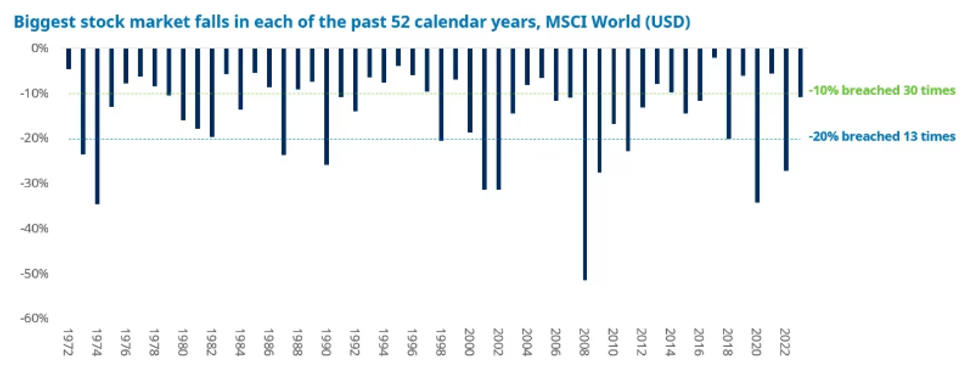
Figures published by Schroders reveal that between 1971 and 2023, stock market declines of 10% or more on the MSCI World Index occurred in the majority of years.

Source: Schroders

The graph shows that the market fell 10% or more in 30 out of 52 years, while declines of 20% or more happened in 13 years.

So, even headline-grabbing market dips, such as those reported in April 2025 following President Trump’s trade tariff announcement, are usually no cause for panic. They’re just part of the market’s natural rhythm.

Markets typically recover over the long term

Market volatility is both normal and temporary. Even the most significant corrections and crashes typically stabilise over time.

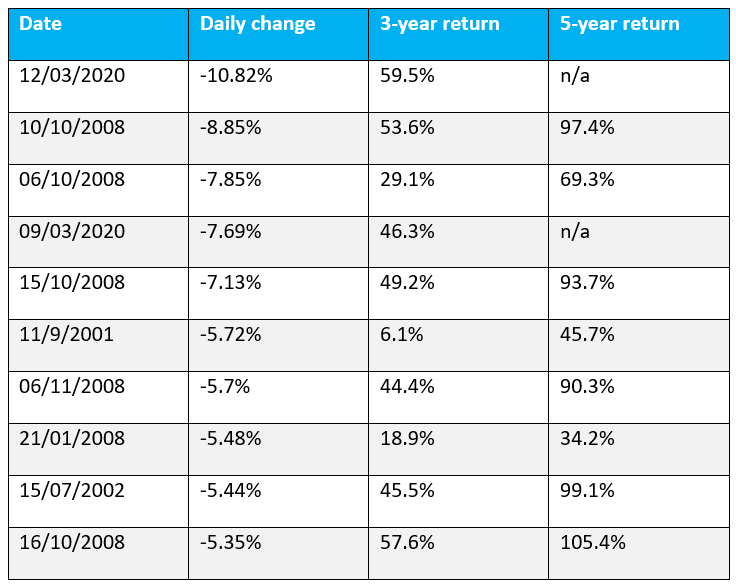
The chart below from Fidelity shows the 10 biggest one-day falls for the UK stock market, measured by the FTSE 100, as well as the subsequent three- and five-year returns.

Source: Fidelity

As you can see, over time, the markets recovered. As such, those who resisted the instinct to panic sell their shares and remained invested made gains in the long term.

The fluctuating market value of the technology company Nvidia further demonstrates the potential benefits of long-term investing.

On 27 January 2025, CNBC reported that Nvidia shares had fallen by 17%, resulting in a loss of almost $600 billion. This represents the biggest drop ever for a US company. However, by 9 July Forbes reported that the tech giant had made a huge comeback, becoming the first $4 trillion company ever.

So, had you sold your Nvidia shares after the January drop, you might have lost out on the subsequent gains.

While Nvidia stock fell again in the first week of November, its historic performance shows how impressively the market can recover over time.

4 ways to stay calm when the markets are volatile

If market volatility still makes you anxious about your investments, here are four tips for staying calm and avoiding emotional decisions.

1. Tune out the noise of market highs and corrections

In today’s technologically advanced world, you might be bombarded every day with investment-related news, whether through social media, the television, or even word of mouth.

Unfortunately, all this noise could make it harder to keep your emotions in check and avoid impulsive decisions, such as rushing to snap up an “unmissable” opportunity or sell shares that are falling in value.

That’s why experienced investors filter and limit the news sources they listen to and only check their portfolio every quarter.

2. Focus on your long-term goals

A cornerstone of effective investing is staying focused on your long-term goals, rather than the market.

As mentioned above, short-term market fluctuations are inevitable, and obsessively monitoring them could result in stress and poor choices.

Instead, anchoring your decisions to your goals could make market volatility less distracting and worrying.

It may also reduce the temptation to “follow the herd” – that is, to buy or sell shares based on other investors’ behaviours rather than your objectives.

Remember, you’re investing to make your life better, be that to retire early or to leave a meaningful legacy to loved ones. As such, an investment strategy that works for someone else might not be a good fit for you. That’s why your long-term goals need to be your priority.

3. Maintain a diversified portfolio

Spreading your wealth across different types of asset classes and geographical areas is known as diversification.

This strategy could help you stay calm because you’ll have peace of mind that no single event is likely to affect your entire portfolio. This is because different types of investments respond to different events. As such, some may fall in value while others make gains.

In contrast, if your portfolio is weighted heavily in one sector or region, this could leave you vulnerable to sudden market downturns.

4. Speak to a financial planner

Reviewing your investments periodically (or if your circumstances change) with a financial planner could help you avoid making emotional decisions. It could also ensure that the level of risk in your portfolio is effectively balanced and aligned with your goals.

Get in touch

If you struggle to remain calm and in control of your investments during periods of market volatility, we can provide the objective advice you need to stay on track to achieve your goals.

Please email hello@bluewealth.co.uk or call us on 0117 332 0230.

Please note

The content of this newsletter is offered only for general informational and educational purposes. It is not offered as, and does not constitute, financial advice.

Blue Wealth Ltd is not responsible for the accuracy of the information contained within linked sites.

Blue Wealth Ltd is an appointed representative of Best Practice IFA Group Ltd, which is authorised and regulated by the Financial Conduct Authority.

The value of your investments (and any income from them) can go down as well as up and you may not get back the full amount you invested. Past performance is not a reliable indicator of future performance.

Investments should be considered over the longer term and should fit in with your overall attitude to risk and financial circumstances.

Approved by Best Practice IFA Group: 25/11/25


Your Autumn Budget update, and what it means for you

After months of speculation and rumour, chancellor Rachel Reeves has delivered the Autumn Budget for 2025. In this update, we’ll explain the key changes and what they mean for you.

Last year, in her maiden Budget, the chancellor sought to balance the public finances with tax rises to cover a reported £22 billion black hole.

This year, Reeves arguably faced an even more difficult landscape. In turn, she has announced an estimated £26 billion of tax rises by 2029/30.

The chancellor had to start her speech, however, by acknowledging the “deeply disappointing” and “serious error” of the Budget announcements being released early by the Office for Budget Responsibility (OBR).

It’s also notable how many predictions ultimately proved to be wide of the mark.

Now that we know exactly what’s included, it’s important to understand the changes and how they could affect you.

The headlines regarding GDP, national debt, and inflation

The chancellor says the government’s plans will reduce borrowing more over the rest of this parliament than any country in the G7.

GDP is expected to grow by 1.5% in 2025, higher than the OBR’s 1% forecast from earlier this year. In subsequent years, the estimations are as follows:

  • In 2026, the economy is forecast to grow by 1.4%, below the previous forecast of 1.9%.
  • In 2027, GDP is forecast to expand by 1.6%, falling short of March’s estimate of 1.8%.
  • In 2028, GDP is estimated to rise by 1.5%. In March of this year, the OBR said this figure would be 1.7%.
  • In 2029, the economy will expand by 1.5%, again falling short of the previous estimate of 1.8%.

Due to weaker underlying productivity growth, the OBR estimates that tax receipts will be £16 billion lower in 2029/30 than initially forecast in March 2025.

Average inflation is expected to fall over the next three years.

  • In 2025: 3.5%, an increase of 0.2% from the OBR’s original forecast.
  • In 2026: 2.5%, up from the OBR’s 2.1% forecast from March.
  • In 2027: 2%.

National debt will stand at £2.6 trillion this year. £1 in every £10 the government spends is on debt interest.

Tax threshold freezes extended until 2031

The Labour manifesto promised not to increase Income Tax or National Insurance (NI), and despite pre-Budget speculation, the government has kept to that promise in this Budget.

However, the chancellor did announce that the Income Tax thresholds will remain frozen for a further three years beyond the previous 2028 freeze, staying where they are until April 2031. This move will raise £8 billion for the government. Similarly, the Inheritance Tax (IHT) threshold freeze is extended from 2030 to 2031.

While this will not increase your Income Tax or IHT bills directly, this fiscal drag means more of your income and wealth may be exposed to tax over time.

The government is also upholding its commitment to bringing pension pots into the scope of IHT from April 2027, and reforms to relief for business and agricultural assets from April 2026.

The tax rates on dividends, savings, and property income will rise by two percentage points

Tax rates are set to rise for dividends, savings, and property income.

  • Dividends: From April 2026, ordinary and upper rates of tax on dividend income will rise by two percentage points to 10.75% and 35.75% respectively. There is no change to the additional rate, which will remain at 39.35%.
  • Property and savings: From April 2027, the rate of tax on property and savings income will increase by two percentage points across all tax bands to 22%, 42%, and 47% respectively.

The government confirmed that, even after these reforms, 90% of taxpayers will still pay no tax on their savings. However, these changes are set to impact business owners and landlords.

The chancellor says these increases will raise £2.2 billion in 2029/30.

The ISA allowance will be reformed for under-65s, and some allowances have been frozen

The chancellor announced that from April 2027, the Individual Savings Account (ISA) allowance will change for under-65s.

As it stands, adults can contribute £20,000 across their ISAs, including Cash ISAs and Stocks and Shares ISAs, each tax year.

From April 2027, £8,000 of this allowance will be reserved exclusively for investments, leaving an available £12,000 that savers can pay into their non-investment accounts, such as Cash ISAs.

Savers over the age of 65 will continue to be able to save up to £20,000 in a Cash ISA each year.

The allowances for Junior ISAs and Lifetime ISAs are frozen until April 2031 at £9,000 and £4,000 a year, respectively.

Salary sacrifice on pension contributions to be capped at £2,000

The chancellor put a cap on NI-efficient pension contributions made under salary sacrifice.

Salary sacrifice schemes cost the government £2.8 billion in 2016/17, but this figure was set to triple to £8 billion by 2030/31.

The government will charge employer and employee National Insurance contributions (NICs) on pension contributions above £2,000 a year made via salary sacrifice. This will take effect from 6 April 2029.

The chancellor says that many of those on low and middle incomes will be able to continue using salary sacrifice as normal, while high earners can expect to pay increased NI.

New “mansion tax” on high-value properties

The chancellor announced the much-speculated “mansion tax” that will affect the top 1% of properties.

The new property surcharge will be paid alongside Council Tax.

There will be four price bands starting with £2,500 for a property valued between £2 million and £2.5 million. For properties valued more than £5 million, the levy will be £7,500.

The measure is estimated to raise £400 million by 2031.

Welfare reforms expected to increase by 2029/30

The BBC reported that changes to the government’s previously announced winter fuel payments and health-related benefits will cost £7 billion in 2029/30.

In addition, Reeves revealed she would remove the two-child benefit cap. This will cost £3 billion by 2029/30.

State Pension: Removal of overseas access to Class 2 National Insurance contributions and committing to the triple lock 

As a result of a loophole in the Class 2 voluntary NICs regime, overseas individuals with a limited connection to the UK can build a State Pension entitlement through cheaper rates.

The government is looking to end this by removing access to the cheapest Class 2 NICs for these individuals. Additionally, it will increase the initial residency or contribution requirements for those living outside the UK.

The chancellor also confirmed the government’s commitment to the triple lock. From April 2026, this will increase the basic and new State Pension by 4.8%, offering up to an additional £575 per year to pensioners, depending on their entitlement.

A range of significant changes for business owners

In addition to the Dividend Tax increase, the chancellor announced a range of changes that could affect business owners, including:

  • Increases to both the National Living Wage (NLW) and National Minimum Wage (NMW). From 1 April 2026, the NLW paid to workers aged 21 and over will rise by 4.1%, from £12.21 to £12.71 an hour, increasing annual income by approximately £900 a year for full-time employees. For those aged 18 to 20, the NMW will rise by 8.5% from £10 to £10.85 an hour, equivalent to around £1,500 a year if working full-time. For 16- and 17-year-olds, and those on apprenticeships, the NMW will rise by 6%, going from £7.55 to £8 an hour.
  • Listing Relief from Stamp Duty Reserve Tax for some businesses. The chancellor said this will “make it easier for entrepreneurs to start, scale, and stay in the UK”.
  • Reduced Capital Gains Tax (CGT) relief for Employee Ownership Trusts (EOTs). When a business is sold to an EOT, CGT relief will fall from 100% to 50% starting from November 2025. This will raise £0.9 billion from 2027/28 onwards.
  • Fully funded apprenticeships for under-25s. This will make them effectively free for small- and medium-sized businesses (SMEs) from April 2026.
  • Lower business rates for more than 750,000 retail, hospitality, and leisure properties. That move will be funded through higher rates on properties worth £500,000 or more, such as warehouses used by online retail.
  • Customs duty will apply to parcels of any value from March 2029 at the latest. There is an existing exemption for parcels worth less than £135, favouring large-scale importers.

Other announcements that may affect you

  • Household energy bills will fall. Reeves is scrapping the Energy Company Obligation (ECO) scheme, saying that on average, families will save £150 a year in 2026.
  • A new tax on electric vehicles. The Electric Vehicle Excise Duty (eVED) will come into effect in 2028 and equal 3p per mile for battery electric cars and 1.5p per mile for plug-in hybrids. The rate per mile will increase annually in line with the CPI.
  • Fuel duty will be frozen until September 2026. In addition, a new “fuel finder” will help drivers find the cheapest fuel, saving the average household £40 a year.
  • Reducing the levy threshold on soft drinks. From 1 January 2028, the sugar tax will also be applied to milk-based drinks, including bottled milkshakes and lattes.
  • A spousal exemption for agricultural and business asset IHT relief. Unused combined business and agricultural asset IHT relief will become transferable between spouses and civil partners.
  • Tobacco Duty and Alcohol Duty will both be uprated. Tobacco Duty will be uprated as announced last year, and Alcohol Duty will now rise with inflation.
  • Rising taxes on online gambling. From April 2026, Remote Gaming Duty will increase by 21% to 40%. A new Remote Betting Rate set at 25% will be introduced from April 2027, though horse race betting will be exempt from the changes.

Other key thresholds that remain the same

More broadly, the chancellor made no mention of other key thresholds that will remain the same. These include:

  • The pension Annual Allowance
  • Stamp Duty Land Tax for residential properties
  • The headline rates of Income Tax, NI, and VAT, as outlined in the government’s election manifesto.

Please note

All information is from the Budget documents on this page.

The content of this Autumn Budget summary is intended for general information purposes only. The content should not be relied upon in its entirety and shall not be deemed to be or constitute advice.

While we believe this interpretation to be correct, it cannot be guaranteed, and we cannot accept any responsibility for any action taken or refrained from being taken as a result of the information contained within this summary. Please obtain professional advice before entering into or altering any new arrangement.

Approved by Best Practice IFA Group Limited on 26/11/2025.

Guide: Everything you need to know about the State Pension

Having a stable income when you retire could give you the independence to enjoy a meaningful and fulfilling life after work. Indeed, a July 2023 survey by Legal & General found that 94% of UK adults said that financial security was their most important retirement dream.

Your State Pension, along with other savings and investments, could provide the stability you need to support the retirement lifestyle you want.

However, there is a worrying lack of understanding about the State Pension among UK adults.

The Retirement Voice report published in April 2025 by Standard Life revealed that:

  • 50% of UK adults don’t know how much they’ll receive in their State Pension
  • 32% are unaware of their State Pension Age.

So, this useful guide explains the essential things you need to know about the State Pension, from when and how you can claim it to how the income it provides will increase during your retirement.

Download your copy here: Everything you need to know about the State Pension

If you have any questions about your State Pension entitlement and how it could supplement other sources of income in retirement, please get in touch.

Please note: This guide is for general information only and does not constitute advice. The information is aimed at retail clients only.