If you’re retired or approaching retirement, you may have considered the possibility of selling up and downsizing. Maybe the buoyant property market during the last few months has motivated you to make the move?
Read on for information about the current housing market and what you should consider before you cash in and scale down your home.
The UK property market is enjoying a boom
Figures released by Nationwide revealed that UK house prices rose 13.4% in the 12 months since June 2020; the fastest pace seen since November 2004. Growth has been pushed by the temporary Stamp Duty cut, but we’re yet to see what will happen once this tax break ends.
The UK property market has been rising since the government first introduced the Stamp Duty holiday. While the biggest savings opportunity has passed, you can still save up to £2,500 if you buy a home before the end of September 2021.
Stamp Duty only applies in England and Northern Ireland. If you’re purchasing property in Wales, you’ll have to pay Land Transaction Tax on main amounts over £180,000 on residential properties. In Scotland you’ll be charged Land and Buildings Transaction Tax and, again, rates vary.
How the Stamp Duty reduction works
You only have to pay Stamp Duty on amounts over £250,000 if you purchase residential property between now and 30 September 2021. If you’re a first-time buyer, you don’t pay Stamp Duty up to £300,000.
The table below will help you work out the Stamp Duty you might owe on a first residential purchase (note that the rates for second homes and buy-to-let properties will be higher):
| Property value |
Stamp Duty rate |
| Up to £250,000 |
Zero |
| The next £675,000 (portion between £250,001 to £925,000) |
5% |
| The next £575,000 (portion from £925,001 to £1.5 million) |
10% |
| The remaining amount (portion above £1.5 million) |
12% |
The number of homes being sold rose significantly during the Stamp Duty holiday
Data from HMRC suggests that 198,240 sales completed in June 2021.
The enticement to beat the 30 June Stamp Duty deadline probably gave these figures a boost as, before that date, you only had to pay duty on anything above £500,000.
The chart below shows the number of house sales registered each month since the start of 2020 and illustrates how the Stamp Duty holiday affected the number of sales completed.
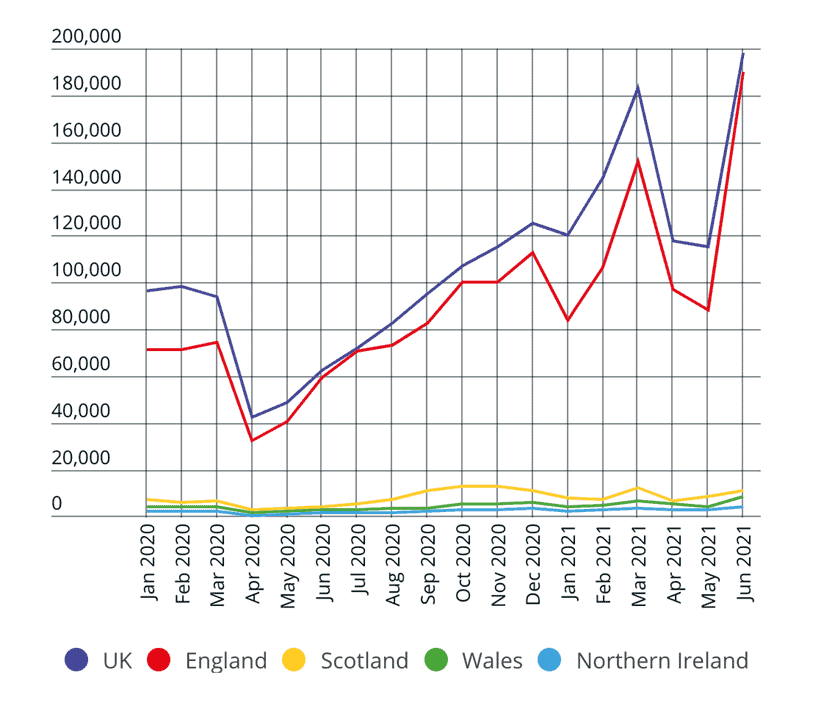
Source: Which? From HMRC, 21 July 2021. Figures represent all residential property transactions of £40,000 or above. Figures for April, May and June 2021 are provisional.
The Stamp Duty holiday undoubtedly helped to increase home sales. However, once the tax breaks and government support schemes end, this buoyancy is unlikely to last.
Lack of supply could keep prices high
According to estate agencies, the rise in buyer demand hasn’t been matched with a glut of new properties coming on the market. This imbalance could help keep prices high in the final few months of 2021, but this has yet to be seen.
As well as supply and demand, the general health of the economy and interest rates also influence house prices. While we can all admit the economy has seen better days, the current low interest rates make it cheaper to borrow and this could help sustain house prices.
Make sure you move for the right reasons
If all of this has got you looking around and thinking now’s the time to cash in, sell up and find somewhere smaller to live, make sure you’re moving for the right reasons.
People choose to move home in later life for a variety of reasons. You may want to move somewhere different or closer to family. Or maybe you’ve had a health scare or lost a loved one and this has made you assess your living arrangements.
Whatever the circumstances, a pros and cons list is a great way to help you decide if downsizing is the right move for you.
These pros and cons might be a good place to start.
Advantages of downsizing
Release equity
If you’ve owned your home for years, you’ve probably seen it increase in value. You might have already paid off your mortgage or be very close to doing so. Buying something smaller – and cheaper – will help you release equity and give you extra money to spend or invest to boost your retirement income.
Reduce maintenance
A smaller property usually means less maintenance and may suit your needs better as you get older.
Reduce your bills
Smaller homes are usually cheaper to run. You might see a reduction in Council Tax, and heating your smaller house should be cheaper too.
Move to a more suitable location
If you’re no longer working, or the pandemic has meant you can continue to work remotely, you have the freedom to choose a property in a different location. You may wish to move closer to friends or family, or to find somewhere more convenient and closer to local shops and services.
Disadvantages of downsizing
Your children might want to come home
Your children may have left home, but are they gone for good? High house prices and rent costs mean that more adult children are choosing to live with their parents. If this happened, would you have the space to accommodate them?
You don’t want to leave
Leaving the family home is likely to be emotional, especially if you have lived in the same house for years and raised your children there. Make sure the whole family is ready to say goodbye to the house you love by having open conversations about your plans. Don’t rush into a decision you might later regret.
Leaving friends and neighbours behind
Moving closer to family may mean leaving behind your close network of friends and neighbours, and you might end up with less day-to-day social contact. This could put more responsibility on your friends and family, which could leave you feeling uncomfortable.
Hard to find a home to love
After years of living in a large home, you may find it difficult to find a property that doesn’t leave you feeling claustrophobic with smaller rooms and little outside space.
Lack of options within your budget
Smaller isn’t always cheaper. If there is a lack of smaller properties in the area you hope to move, you may find houses aren’t as cheap as you expected.
Think things through carefully before you decide to downsize
Selling the family home and downsizing to somewhere smaller and cheaper can present significant financial advantages, but it’s not a decision you should take lightly. If you don’t plan and think things through, you could end up unhappy with less money than you had hoped, less space, and less flexibility than you want.
If you want to understand more about the implications of releasing equity from your family home and how much it could boost your retirement income, we can help.
Please email hello@bluewealth.co.uk or call us on 0117 332 0230 to discuss your goals and desires.
Please note
This article is for information only. Please do not act based on anything you might read in this article. All contents are based on our understanding of HMRC legislation, which is subject to change.
Your home may be repossessed if you do not keep up repayments on a mortgage or other loans secured on it.
Think carefully before securing other debts against your home.