
To help stabilise the energy market, Ofgem, the body that regulates energy in the UK, has decided to review the energy price cap every three months, instead of six months.
Ofgem has said that this move should help to minimise the number of suppliers going bust, after dozens have failed in the past couple of years.
But with energy bills soaring, understanding what’s going on in the energy market – and how that affects your payments – has never been more important.
Read on to find more about what the price cap is, why energy prices have gone up, and how your gas and electricity bills might be affected.
Why is energy getting so expensive?
Although the price of energy is one of the hottest topics around, prices have been creeping up for months.
Energy prices have soared in the UK and globally for a number of reasons. Demand for energy plummeted during the pandemic. But, as we returned to the new normal, demand has rocketed – not only in the UK, but around the world.
Russia’s invasion of Ukraine has also worsened energy prices considerably.
While the UK isn’t massively dependent on Russia for natural gas, Europe used to import 40% of its gas from Russia and 29% of its oil from Russia.
What is the energy price cap?
The price cap sets the maximum amount that energy companies are allowed to charge households for each unit of energy they use (the kilowatt hour or kWh on your bills). It also limits the standing charge, which is the standard fee you pay for being connected to the energy grid.
So, the cap is the maximum price per kilowatt hour (kWH) of energy, plus standing charges, that providers can charge you for gas and electricity.
In her first week on the job, new prime minister, Liz Truss has fixed the energy price cap at £2,500 a year for a typical home for two years.
This cap will come into place on 1 October and is expected to save the average household £1,000 a year.
How might the energy price rise affect me?
The most important thing to remember is that the amount you’ll actually pay depends on the amount of energy you use.
If you use more energy, you will pay more, use less and you’ll pay less.
You won’t be affected by the price cap if you are on a fixed tariff and your usage hasn’t changed dramatically, or you are on a standard variable green tariff, which Ofgem has not included in the cap.
If your payments are rising, your energy company must tell you before any increase is made. They should also explain why this is happening.
An increase may be due to the higher price cap, but it could also be due to estimates of your energy consumption by the supplier. If you think you’re overpaying, you can challenge these with meter readings.
If you’re on a fixed tariff, your unit rates and standard charge won’t change for the duration of your contract. However, your payments can change if your consumption increases or isn’t in line with the estimates provided when you first signed up with your supplier.
Don’t assume that what you’re being charged is correct
Even if your usage is in line with what’s expected, mistakes can and do happen. This could be due to a variety of reasons, including computer errors or providers simply making incorrect estimates of energy consumption.
At Blue Wealth, we’ve heard from several people who have received bills with estimate readings that have proved to be far more than the energy that’s actually used.
If you receive an estimated bill from your energy company, it’s wise to check your meter readings for your actual use and share these with your supplier before you pay the bill.
In light of the new price cap, officials estimate that the annual saving is likely to range from an average £650 for a well-insulated purpose-built flat – where typical bills will be cut from an expected £2,400 to £1,750 – to £1,400 for a detached home – where the cost will fall from an expected £3,800 to £2,650.
5 ways to reduce your energy bill
1. Look for ways to use less energy
Small changes to energy habits can help reduce bills, such as taking quicker showers and hanging clothes to dry instead of using a tumble dryer. Washing your clothes on a 30-degree cycle instead of higher temperatures can also make a difference to your energy usage.
2. Switch to more efficient forms of energy
Look for ways to use less energy where possible. For example, avoid energy waste by turning off lights when you leave a room and use more energy-efficient LED bulbs.
The chart below is a useful measure of where you may find it possible to make savings through changing your usage habits.
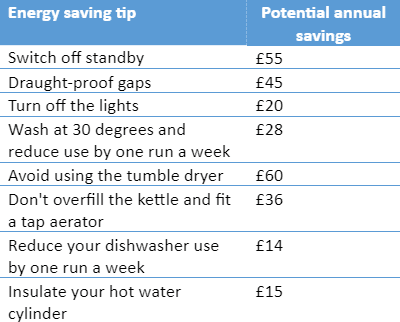
Source: Energy Saving Trust
3. Pay by direct debit
Prepaid meters charge customers a lot more for electricity, so consider moving to a direct debit option, which could help reduce your tariff costs.
4. Use a smart meter
Smart meters help you monitor your energy usage and its corresponding costs in real time. This may allow you to see where your biggest spending happens and adjust how you use energy in your home, which can help to keep your bills low.
5. Check for any competitive fixed-term deals still available
If it’s been a long time since you changed your tariff, or you’re on the default standard or variable tariff, you’re probably paying more for your energy. Check comparison sites such as uswitch.com to find a competitive fixed-term tariff that can fix the amount you pay for up to two years.
What is the government doing to help?
On top of Liz Truss fixing the energy price cap at £2,500, all UK households will be given a one-off £400 discount on their fuel bills from October. This will take the form of monthly payments over six months from October to March 2023.
There’s no need to take any action – payments will be applied to your bills by your electricity supplier. However, if you haven’t received the first instalment by the end of October 2022, you should get in touch with your energy supplier.
Meanwhile, £650 will be paid to more than 8 million low-income households who receive benefits or tax credits. And further payments of £300 will go to pensioner households and £150 to disabled people.
Get in touch
If you’re concerned about the rising cost of living and how this might affect your current and long-term financial plan, please get in touch. Email hello@bluewealth.co.uk or call us on 0117 332 0230.
Please note:
The content of this newsletter is offered only for general informational and educational purposes. It is not offered as and does not constitute financial advice.




 About BillyChip







 Naomi is our new trainee paraplanner. Arriving from another firm in Bristol, here she tells us a bit more about what she’s been up to since joining the team at Blue Wealth.
 What is your background, can you tell us a bit about your journey to becoming a financial planner?